DrugClass
Human Body & Drugs
Human Pancreas and Diabetes Drugs: GPAT Pharmacology Guide
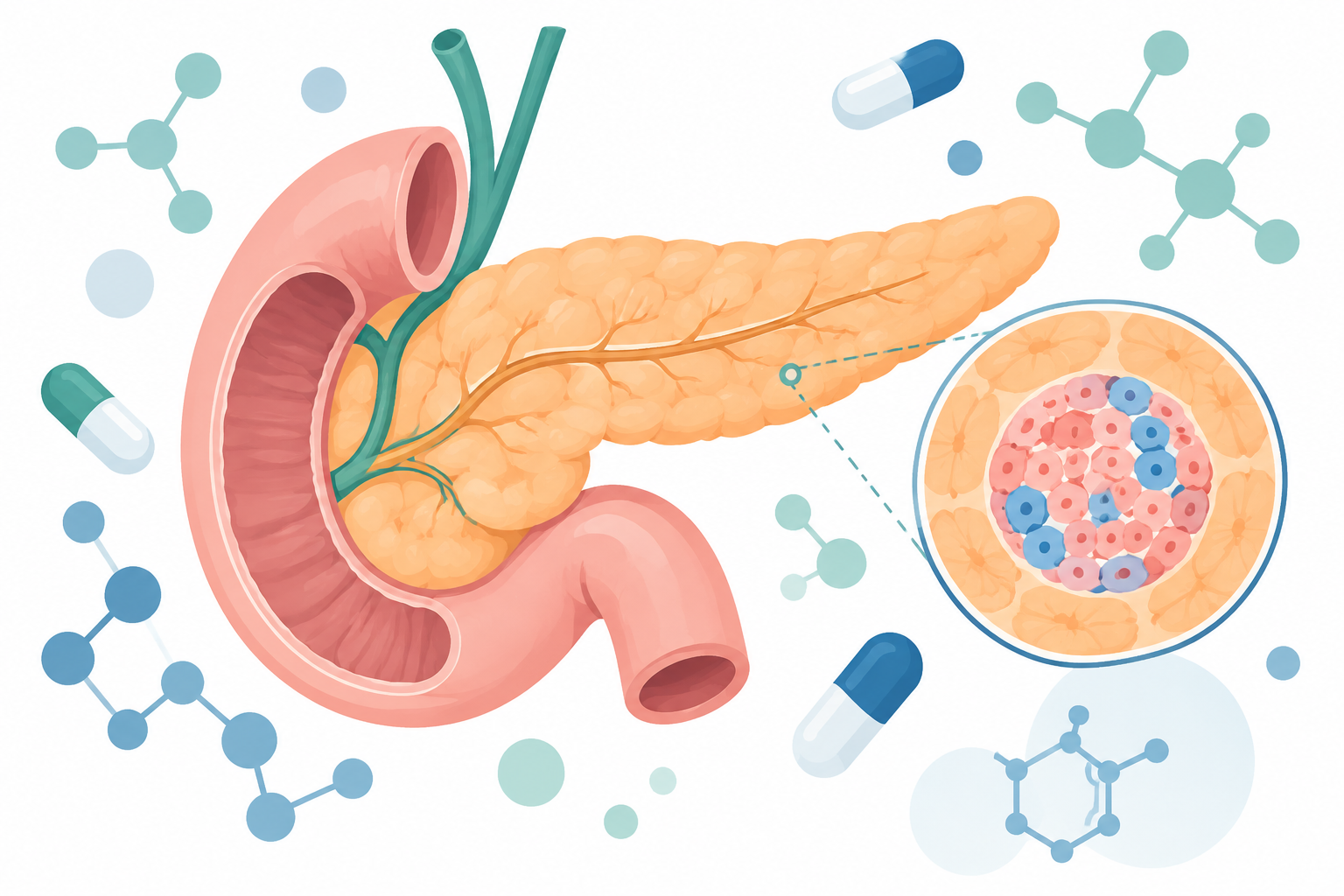
The human pancreas controls blood sugar levels using hormones like insulin and glucagon. When this system fails, diabetes mellitus develops, requiring oral hypoglycemic agents or insulin therapy. This guide reviews pancreatic function, major antidiabetic drug classes, standard doses, and high-yield GPAT notes.
What is it?
The pancreas is a mixed gland located behind the stomach. It has both exocrine and endocrine functions. The endocrine part consists of small cell clusters called the Islets of Langerhans. These islets make up about one to two percent of the total pancreatic mass.
The Islets of Langerhans contain four main types of cells:
- Beta (β) cells: Make and release insulin (about 60% of islet cells).
- Alpha (α) cells: Produce glucagon to raise blood sugar.
- Delta (δ) cells: Secrete somatostatin to inhibit both insulin and glucagon.
- PP cells (F cells): Produce pancreatic polypeptide.
Diabetes mellitus is a metabolic disorder marked by chronic hyperglycemia. It occurs due to defects in insulin secretion, insulin action, or both.
There are two primary types:
- Type 1 Diabetes Mellitus (T1DM): Autoimmune destruction of pancreatic beta cells leads to absolute insulin deficiency. Patients require lifelong insulin replacement.
- Type 2 Diabetes Mellitus (T2DM): Insulin resistance combined with relative insulin deficiency. Patients are treated with lifestyle modifications, oral antidiabetic drugs, and injectable therapies.
Salt and Composition
Diabetes drugs fall into several distinct chemical and pharmacological classes. Below are common textbook examples:
-
Biguanides (Metformin)
- Salt / Form: Metformin Hydrochloride.
- Common Strengths: 500 mg, 850 mg, 1000 mg tablets (immediate and extended-release).
- Brand Examples: Glycomet, Glucophage.
-
Sulfonylureas (Glimepiride)
- Salt / Form: Glimepiride.
- Common Strengths: 1 mg, 2 mg, 3 mg, 4 mg tablets.
- Brand Examples: Amaryl, Zoryl.
-
Dipeptidyl Peptidase-4 (DPP-4) Inhibitors (Sitagliptin)
- Salt / Form: Sitagliptin Phosphate.
- Common Strengths: 25 mg, 50 mg, 100 mg tablets.
- Brand Examples: Januvia, Istavel.
-
Human Insulin (Regular)
- Salt / Form: Regular Soluble Human Insulin (Recombinant DNA origin).
- Common Strengths: 40 IU/mL, 100 IU/mL injectable solution.
- Brand Examples: Huminsulin R, Actrapid.
Dose Chart
| Drug / Form | Adult Dose | Child Dose |
|---|---|---|
| Metformin HCl (Oral Tablet) | 500 mg once or twice daily with meals; max 2000–2550 mg/day | Age ≥ 10 years: 500 mg once daily; max 2000 mg/day |
| Glimepiride (Oral Tablet) | 1 mg to 2 mg once daily with breakfast; max 8 mg/day | Not recommended in pediatric patients |
| Sitagliptin (Oral Tablet) | 100 mg once daily with or without food | Safety and efficacy not established in children < 18 years |
| Regular Human Insulin (Subcutaneous Injection) | 0.5 to 1.0 IU/kg/day total daily dose (divided before meals) | 0.5 to 1.0 IU/kg/day (individualized by blood sugar monitoring) |
How it Works in the Human Body
The Endocrine Pancreas
In a healthy body, glucose enters beta cells through glucose transporter-2 (GLUT-2). Inside the cell, glucose undergoes glycolysis and generates ATP.
- A rising ATP/ADP ratio closes ATP-sensitive potassium ($K_{ATP}$) channels.
- This closure depolarizes the cell membrane.
- Voltage-gated calcium ($Ca^{2+}$) channels open, letting calcium rush in.
- Intracellular calcium triggers the exocytosis of insulin storage granules into the bloodstream.
Mechanisms of Key Antidiabetic Drugs
- Sulfonylureas (e.g., Glimepiride): Bind to the sulfonylurea receptor (SUR1) subunit on pancreatic beta cells. This blocks $K_{ATP}$ channels, stimulates depolarization, and forces insulin release. Therefore, they require functional beta cells to work.
- Biguanides (e.g., Metformin): Do not stimulate insulin release. Instead, Metformin activates adenosine monophosphate-activated protein kinase (AMPK) in the liver. This suppresses hepatic gluconeogenesis and improves peripheral glucose uptake in skeletal muscle.
- DPP-4 Inhibitors (e.g., Sitagliptin): Inhibit the enzyme DPP-4. This slows the breakdown of incretin hormones like GLP-1. Higher GLP-1 levels stimulate glucose-dependent insulin release from the pancreas and reduce glucagon secretion.
- Exogenous Insulin: Binds to the tyrosine kinase insulin receptor on muscle and fat cells. This causes GLUT-4 transporters to move to the cell surface, allowing rapid entry of glucose from blood into tissues.
Side Effects
- Hypoglycemia: Most common with Sulfonylureas and Insulin. Metformin alone rarely causes hypoglycemia.
- Lactic Acidosis: A rare but severe adverse effect of Metformin, especially in renal impairment.
- Gastrointestinal Disturbances: Metformin causes nausea, metallic taste, abdominal pain, and diarrhea in up to 20% of users.
- Weight Gain: Common with Sulfonylureas and Insulin therapy.
- Weight Neutrality or Mild Loss: Seen with Metformin and DPP-4 inhibitors.
- Lipodystrophy: Can occur at insulin injection sites if injection spots are not rotated.
3 Important Exam Points for GPAT
- Insulin Structure and Chains: Human insulin consists of 51 amino acids across two peptide chains: Chain A (21 amino acids) and Chain B (30 amino acids). They are held together by two interchain disulfide bonds, with one additional intrachain disulfide bond on Chain A.
- Metformin as First-Line Therapy: Metformin is an euglycemic agent. It does not cause insulin secretion or hypoglycemia when given alone. Its primary site of action is the liver, mediated by AMPK activation.
- Molecular Target of Sulfonylureas: Sulfonylureas bind specifically to the SUR1 regulatory subunit of the inwardly rectifying potassium channel ($K_{ir}6.2$) on pancreatic beta cells.
3 MCQs
Question 1
Which transporter is primarily responsible for glucose-stimulated insulin release by sensing glucose in pancreatic beta cells?
A) GLUT-1
B) GLUT-2
C) GLUT-3
D) GLUT-4
Answer: B
Question 2
Human insulin contains 51 amino acids. How many amino acids are present in Chain A?
A) 21
B) 30
C) 31
D) 20
Answer: A
Question 3
Which antidiabetic agent activates AMP-activated protein kinase (AMPK) to reduce hepatic glucose production?
A) Glipizide
B) Pioglitazone
C) Metformin
D) Acarbose
Answer: C
FAQs
Why does Metformin not cause hypoglycemia as a monotherapy?
Metformin does not force pancreatic beta cells to release insulin. It works mainly by reducing hepatic glucose production and improving peripheral tissue sensitivity. Because insulin levels do not spike artificially, normal glucose regulation remains intact.
What is the role of Zinc in insulin formulations?
Zinc forms a hexamer complex with insulin molecules. This stabilizes the peptide structure and slows absorption from subcutaneous tissue, which is used to design intermediate-acting and long-acting insulin preparations.
Which cells of the pancreas secrete glucagon?
Alpha (α) cells of the Islets of Langerhans produce and secrete glucagon. Glucagon acts on the liver to stimulate glycogenolysis and gluconeogenesis, raising blood glucose levels during fasting.
Take Free Test on this Topic
Check what you learned with quick GPAT-style questions.
Start Free Test →Unlock all 14 Classifications and 50+ Mock Tests with our Student Pro plan.
Unlock NowFor educational use only — not medical advice. Always check doses with current prescribing information.