 DrugClass
Drug Salts
Paracetamol and Ibuprofen Combination: Uses, Dose & GPAT Notes
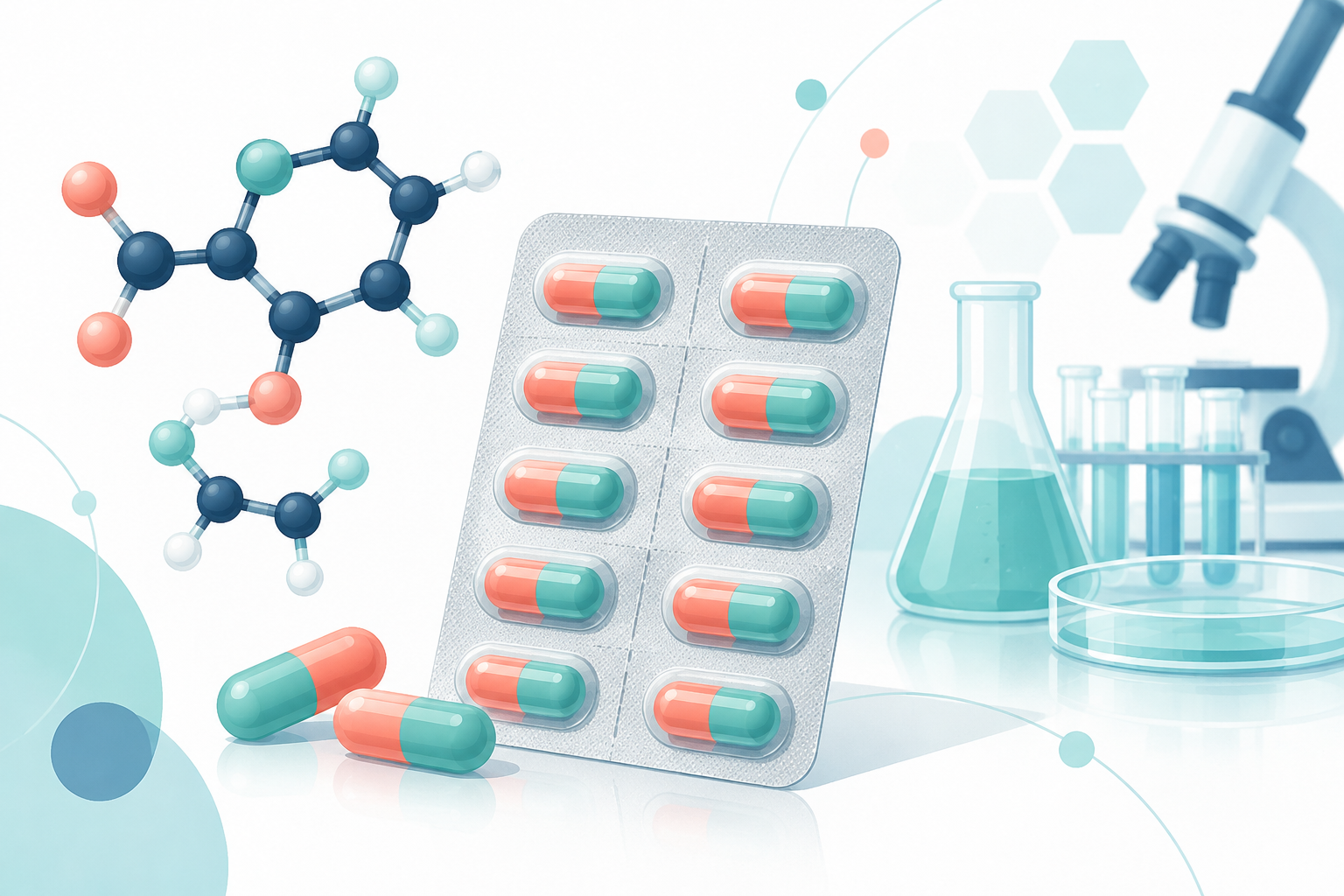
The Paracetamol and Ibuprofen combination is a popular fixed-dose analgesic and antipyretic. It combines central and peripheral pain relief mechanisms for better efficacy. This guide covers its pharmacology, dosing, and key questions for GPAT aspirants.
What is it?
Paracetamol and Ibuprofen is a fixed-dose combination (FDC) medicine. It is used to treat mild to moderate pain and reduce fever.
Paracetamol is a non-opioid analgesic and antipyretic agent. Ibuprofen is a non-steroidal anti-inflammatory drug (NSAID). Together, they provide better pain relief than either drug used alone. Doctors commonly prescribe this combination for headaches, dental pain, body aches, muscle strains, and joint pain.
Salt and Composition
This medicine contains two active pharmaceutical ingredients (APIs):
- Paracetamol (Acetaminophen): Chemically, it is a para-aminophenol derivative ($N$-(4-hydroxyphenyl)acetamide).
- Ibuprofen: Chemically, it is a propionic acid derivative (2-(4-isobutylphenyl)propanoic acid).
Common Strengths
- Standard Adult Tablet: Ibuprofen 400 mg + Paracetamol 325 mg (or 500 mg).
- Lower Strength Tablet: Ibuprofen 200 mg + Paracetamol 325 mg.
- Pediatric Oral Suspension (per 5 mL): Ibuprofen 100 mg + Paracetamol 162.5 mg.
Popular Brand Examples
- Combiflam (Sanofi India)
- Flexon (Aristo Pharmaceuticals)
- Ibugesic Plus (Cipla)
Dose Chart
Always take this combination with or after food to prevent stomach upset.
| Drug / Form | Adult Dose | Child Dose |
|---|---|---|
| Tablet (Ibuprofen 400 mg + Paracetamol 325 mg) | 1 tablet orally every 6 to 8 hours (Max: 3 tablets/day) | Not recommended for children under 12 years |
| Tablet (Ibuprofen 200 mg + Paracetamol 325 mg) | 1 to 2 tablets orally every 6 to 8 hours | Not recommended for children under 12 years |
| Oral Suspension (Per 5 mL: Ibuprofen 100 mg + Paracetamol 162.5 mg) | Not typical for adults | Children (above 6 months): 5 mg/kg Ibuprofen + 8 mg/kg Paracetamol per dose, every 8 hours |
How it Works in the Human Body
This combination works through two distinct, complementary pathways.
Step 1: Absorption
After oral intake, both drugs are quickly absorbed in the small intestine. Paracetamol reaches peak plasma levels in about 30 to 60 minutes. Ibuprofen reaches peak levels in 1 to 2 hours.
Step 2: Peripheral Action (Ibuprofen)
- Body tissue injury causes the release of arachidonic acid.
- Ibuprofen reversibly inhibits the Cyclooxygenase enzymes (COX-1 and COX-2).
- This inhibition stops the conversion of arachidonic acid into prostaglandins ($PGE_2$ and $PGF_2\alpha$).
- Lower prostaglandin levels decrease peripheral nociceptor sensitization, reducing swelling, redness, and inflammatory pain.
Step 3: Central Action (Paracetamol)
- Paracetamol acts mainly in the Central Nervous System (CNS).
- It inhibits prostaglandin synthesis in the brain by acting on peroxidase enzymes and central COX pathways.
- It also activates descending serotonergic pain-blocking pathways.
- In the brain's hypothalamus, Paracetamol acts on the heat-regulating center. It triggers cutaneous vasodilation and sweating. This lowers body temperature during a fever.
Because Ibuprofen works in peripheral tissues and Paracetamol works mainly in the central nervous system, they produce an additive (synergistic) analgesic effect.
Side Effects
Most patients tolerate this medicine well when used for short periods. However, adverse effects can occur:
- Gastrointestinal: Nausea, heartburn, epigastric pain, and gastric ulcers (due to Ibuprofen inhibiting protective COX-1 in the stomach).
- Hepatic: Liver toxicity at excessive doses (due to the Paracetamol metabolite NAPQI).
- Renal: Fluid retention, reduced renal blood flow, or papillary necrosis on long-term use.
- Hypersensitivity: Skin rash, urticaria, or bronchospasm in aspirin-sensitive patients.
3 Important Exam Points for GPAT
- Chemical Classification: Ibuprofen belongs to the propionic acid derivative class of NSAIDs. Paracetamol is a para-aminophenol derivative.
- Toxic Metabolite & Antidote: Overdose of Paracetamol produces NAPQI ($N$-acetyl-$p$-benzoquinone imine) through the CYP2E1 enzyme pathway. When hepatic glutathione is depleted, NAPQI causes hepatic necrosis. The specific antidote is N-Acetylcysteine (NAC).
- Anti-inflammatory Contrast: Ibuprofen has strong peripheral anti-inflammatory action because it inhibits peripheral COX enzymes. Paracetamol has negligible peripheral anti-inflammatory action due to inactivation by local cellular peroxides at inflammatory sites.
3 MCQs
Question 1
What is the primary chemical class of Ibuprofen?
A) Indole acetic acid derivative
B) Propionic acid derivative
C) Salicylate derivative
D) Oxicam derivative
Answer: B
Question 2
Why is Paracetamol combined with Ibuprofen in fixed-dose formulations?
A) Paracetamol prevents gastric ulcers caused by Ibuprofen
B) Ibuprofen accelerates Paracetamol absorption from the stomach
C) They provide synergistic analgesia via central and peripheral pathways
D) Paracetamol induces CYP enzymes to clear Ibuprofen faster
Answer: C
Question 3
Which toxic metabolite of Paracetamol causes hepatic necrosis during an overdose?
A) AM404
B) Homogentisic acid
C) $N$-acetyl-$p$-benzoquinone imine (NAPQI)
D) Benzoic acid
Answer: C
FAQs
Why should this combination be taken after meals?
Ibuprofen inhibits COX-1, which reduces protective mucus and bicarbonate secretion in the stomach lining. Taking it after food minimizes gastric irritation and nausea.
Can this combination be given to a patient with Dengue fever?
No. Ibuprofen impairs platelet aggregation and increases the risk of serious bleeding. Dengue causes low platelet counts, so NSAIDs like Ibuprofen are strictly contraindicated. Only Paracetamol should be used.
What is the maximum daily limit of Paracetamol in this combination?
For a healthy adult, the maximum recommended daily dose of Paracetamol is 4000 mg (4 grams) from all sources combined. Exceeding this limit can cause severe liver damage.
Take Free Test on this Topic
Check what you learned with quick GPAT-style questions.
Start Free Test →Unlock all 14 Classifications and 50+ Mock Tests with our Student Pro plan.
Unlock NowFor educational use only — not medical advice. Always check doses with current prescribing information.