 DrugClass
How Medicine Works in Human Body
Antithyroid Drugs: Propylthiouracil, Methimazole & GPAT Notes
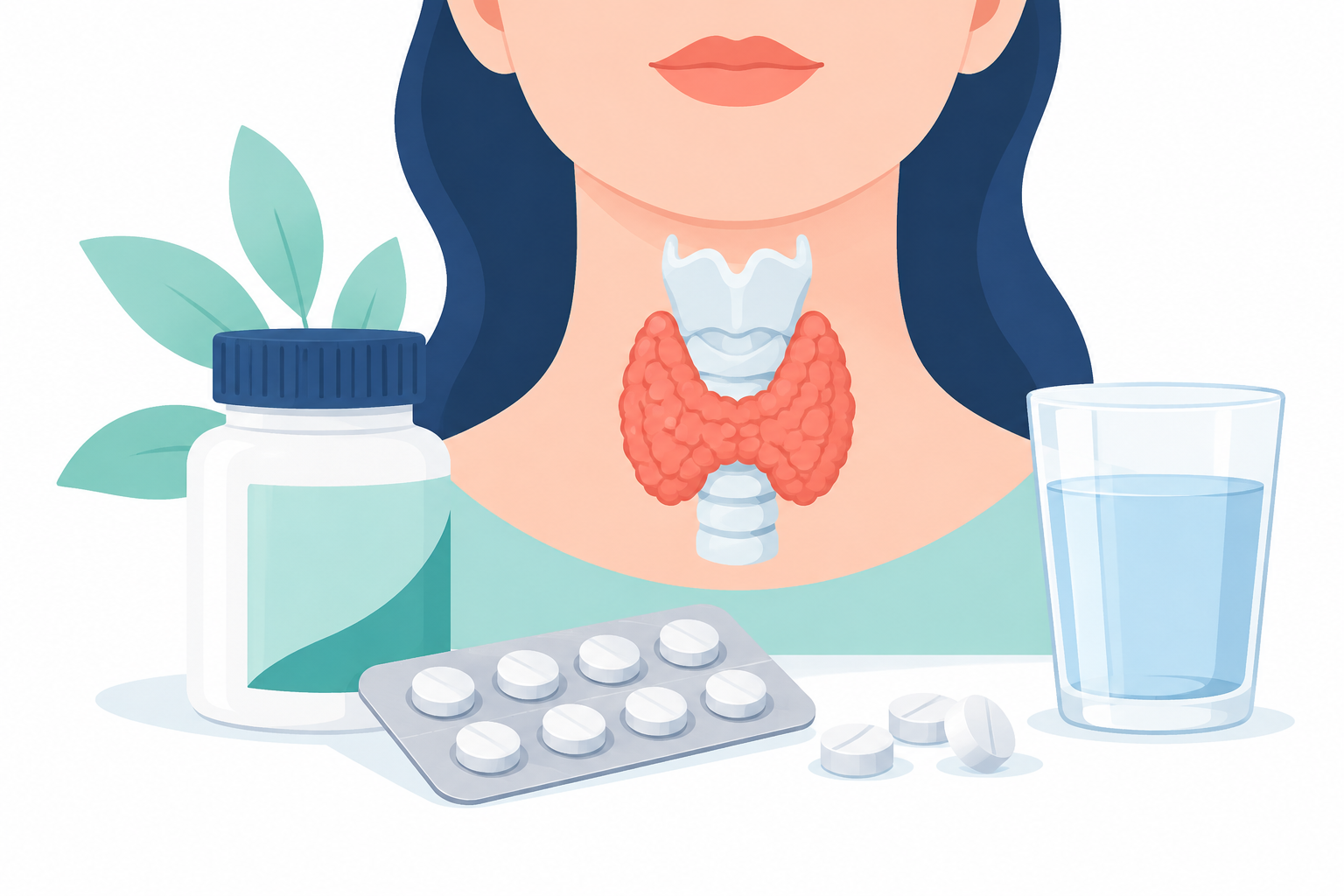
Antithyroid drugs like propylthiouracil and methimazole control hyperthyroidism by blocking thyroid peroxidase and hormone synthesis. This guide details their mechanisms, differences, clinical doses, and high-yield GPAT pharmacology points.
Introduction to Antithyroid Drugs
Antithyroid drugs are chemical agents used to reduce excessive thyroid hormone production in conditions like hyperthyroidism and Graves' disease. In pharmacology competitive exams like GPAT, NIPER, and university boards, questions on antithyroid drugs, propylthiouracil (PTU), and methimazole appear frequently.
To understand how antithyroid medications work, pharmacy students must first understand the steps of thyroid hormone synthesis. The thyroid gland requires active iodide uptake, oxidation, iodination of tyrosine residues, coupling, and peripheral conversion of thyroxine (T4) to active triiodothyronine (T3).
Synthesis of Thyroid Hormones: Quick Review
- Iodide Trapping: Transport of circulating inorganic iodide ($I^-$) into thyroid follicular cells via the Sodium-Iodide Symporter (NIS).
- Oxidation: Iodide is oxidized to elementary iodine ($I^0$ or $I^+$) by the enzyme thyroid peroxidase (TPO) in the presence of hydrogen peroxide.
- Organification (Iodination): Iodine binds to tyrosine residues on thyroglobulin to form Monoiodotyrosine (MIT) and Diiodotyrosine (DIT).
- Coupling: TPO couples MIT and DIT.
- $\text{MIT} + \text{DIT} \rightarrow \text{T3}$ (Triiodothyronine)
- $\text{DIT} + \text{DIT} \rightarrow \text{T4}$ (Thyroxine)
- Hormone Storage and Release: Hormones remain stored in colloid bound to thyroglobulin. Proteolysis releases free T4 and T3 into the bloodstream.
- Peripheral Conversion: Approximately 80% of active T3 in circulation is generated outside the thyroid via 5'-deiodinase in the liver and kidney.
Classification of Antithyroid Drugs
Antithyroid drugs fall into distinct categories based on their site of action in the body:
- Inhibit Thyroid Hormone Synthesis (Thionamides):
- Propylthiouracil (PTU)
- Methimazole
- Carbimazole (prodrug of methimazole)
- Inhibit Iodide Trapping (Ionic Inhibitors):
- Perchlorates ($\text{ClO}_4^-$)
- Thiocyanates ($\text{SCN}^-$)
- Fluoborates
- Inhibit Hormone Release:
- Potassium iodide
- Lugol's iodine (5% elemental iodine + 10% potassium iodide)
- Destroy Thyroid Tissue:
- Radioactive iodine ($^{131}\text{I}$, $^{125}\text{I}$)
- Inhibit Peripheral Conversion of T4 to T3:
- Propylthiouracil (PTU)
- Propranolol
- Dexamethasone (Corticosteroids)
- Ipodate / Iopanoic acid (Oral cholecystographic agents)
Mechanism of Action of Thionamides
Thionamides are the cornerstone of medical therapy for hyperthyroidism. They contain a thiocarbamide group essential for antithyroid activity.
Primary Mechanism
Thionamides diffuse into follicular cells and act as competitive substrates for thyroid peroxidase (TPO). By inhibiting TPO:
- They prevent the oxidation of iodide to elemental iodine.
- They block the iodination of tyrosyl residues (organification).
- They inhibit the coupling of iodotyrosine residues to form T3 and T4.
Because thionamides block synthesis rather than release, clinical improvement takes 2 to 4 weeks. The clinical effect appears only after preformed thyroid hormone reserves in colloid are depleted.
Additional Action of Propylthiouracil (PTU)
Unlike methimazole, propylthiouracil also inhibits peripheral 5'-deiodinase. This enzyme converts T4 to the more active T3 in peripheral tissues. This unique action gives PTU an advantage in treating severe hyperthyroidism and thyroid storm.
Propylthiouracil vs Methimazole: Key Differences
This comparison is one of the most frequently tested concepts in GPAT and NIPER pharmacology.
| Parameter | Propylthiouracil (PTU) | Methimazole | Carbimazole |
|---|---|---|---|
| Potency | Low (1x) | High (~10x more potent than PTU) | Prodrug converted to methimazole |
| Plasma Half-life ($t_{1/2}$) | Short (~1 to 2 hours) | Longer (~6 to 8 hours) | ~6 hours |
| Dosing Frequency | 2 to 3 times daily | Once daily | Once daily |
| Protein Binding | High (~75% to 80%) | Low / Negligible | Low |
| Placental Transfer | Low (less enters placenta/milk) | Readily crosses placenta | Readily crosses placenta |
| First Trimester Pregnancy | Drug of Choice | Avoid (causes teratogenicity) | Avoid |
| 2nd and 3rd Trimester | Avoid (liver risk) | Drug of Choice | Drug of Choice |
| Peripheral T4 to T3 Block | Yes | No | No |
| Primary Organ Toxicity | Severe Hepatotoxicity (Black Box) | Cholestatic Jaundice | Cholestatic Jaundice |
Standard Doses and Administration
- Methimazole:
- Initial dose: 15 mg to 30 mg orally once daily depending on severity.
- Maintenance dose: 5 mg to 10 mg orally once daily.
- Propylthiouracil (PTU):
- Initial dose: 100 mg to 150 mg orally every 8 hours (300 to 450 mg/day).
- Maintenance dose: 50 mg to 100 mg orally once to twice daily.
- Lugol’s Iodine:
- Dose: 5 to 10 drops orally three times daily given for 10 to 14 days before thyroidectomy to reduce vascularity.
Adverse Effects and Toxicity Profile
Understanding the toxicity of thionamides is vital for clinical safety and exam success.
1. Agranulocytosis
- This is the most dangerous adverse effect of thionamides.
- It occurs in 0.2% to 0.5% of patients, usually within the first 90 days of starting therapy.
- Patients must be educated to report fever, sore throat, mouth ulcers, or chills immediately.
- If absolute neutrophil count (ANC) drops below $500/\mu\text{L}$, stop the drug permanently and administer broad-spectrum antibiotics and G-CSF.
2. Hepatotoxicity
- PTU carries an FDA Black Box Warning for severe hepatitis, acute liver failure, and death.
- Methimazole causes cholestatic jaundice rather than fulminant hepatic necrosis.
3. Teratogenicity
- Methimazole causes aplasia cutis congenita (congenital skin defect on the scalp), choanal atresia, and esophageal atresia.
- PTU is safer in the first trimester because high protein binding limits placental transfer.
Thyroid Storm: GPAT Emergency Protocol
Thyroid storm (thyrotoxic crisis) is a life-threatening complication of uncontrolled hyperthyroidism. The standard multi-drug protocol includes:
- Propylthiouracil (PTU): Given in high doses (200 mg every 4 hours orally or via NG tube) to block hormone synthesis and peripheral T4 to T3 conversion.
- Propranolol (Beta-blocker): Controls severe tachycardia and agitation; high doses also inhibit peripheral conversion.
- Potassium Iodide or Lugol's Iodine: Administered at least 1 hour after starting PTU (to prevent the iodide from being used as fuel for new hormone synthesis). Inhibits hormone release via the Wolff-Chaikoff effect.
- Hydrocortisone: Protects against relative adrenal insufficiency and reduces peripheral conversion.
Summary of High-Yield Exam Points
- TPO is the primary target of PTU, methimazole, and carbimazole.
- PTU blocks 5'-deiodinase; methimazole does not.
- Pregnancy rules: PTU for 1st trimester; Methimazole for 2nd and 3rd trimesters.
- Carbimazole is a prodrug activated in vivo to methimazole.
- Sore throat and fever = suspect agranulocytosis and check WBC count immediately.
Test Yourself: 5 MCQs
1. Which of the following antithyroid drugs inhibits the peripheral conversion of thyroxine (T4) to triiodothyronine (T3)?
2. Aplasia cutis congenita is a known teratogenic risk associated with which antithyroid drug?
3. What is the most serious and life-threatening adverse reaction associated with thionamide therapy?
4. The temporary reduction in thyroid hormone synthesis caused by high concentrations of inorganic iodide is known as:
5. Which antithyroid agent is considered the first-line choice during the first trimester of pregnancy?
Take Free Test on this Topic
Check what you learned with quick GPAT-style questions.
Start Free Test →Unlock all 14 Classifications and 50+ Mock Tests with our Student Pro plan.
Unlock NowFor educational use only — not medical advice. Always check doses with current prescribing information.