 DrugClass
Pharmacology Easy Notes
Zero Order and First Order Kinetics: GPAT Pharmacology Notes
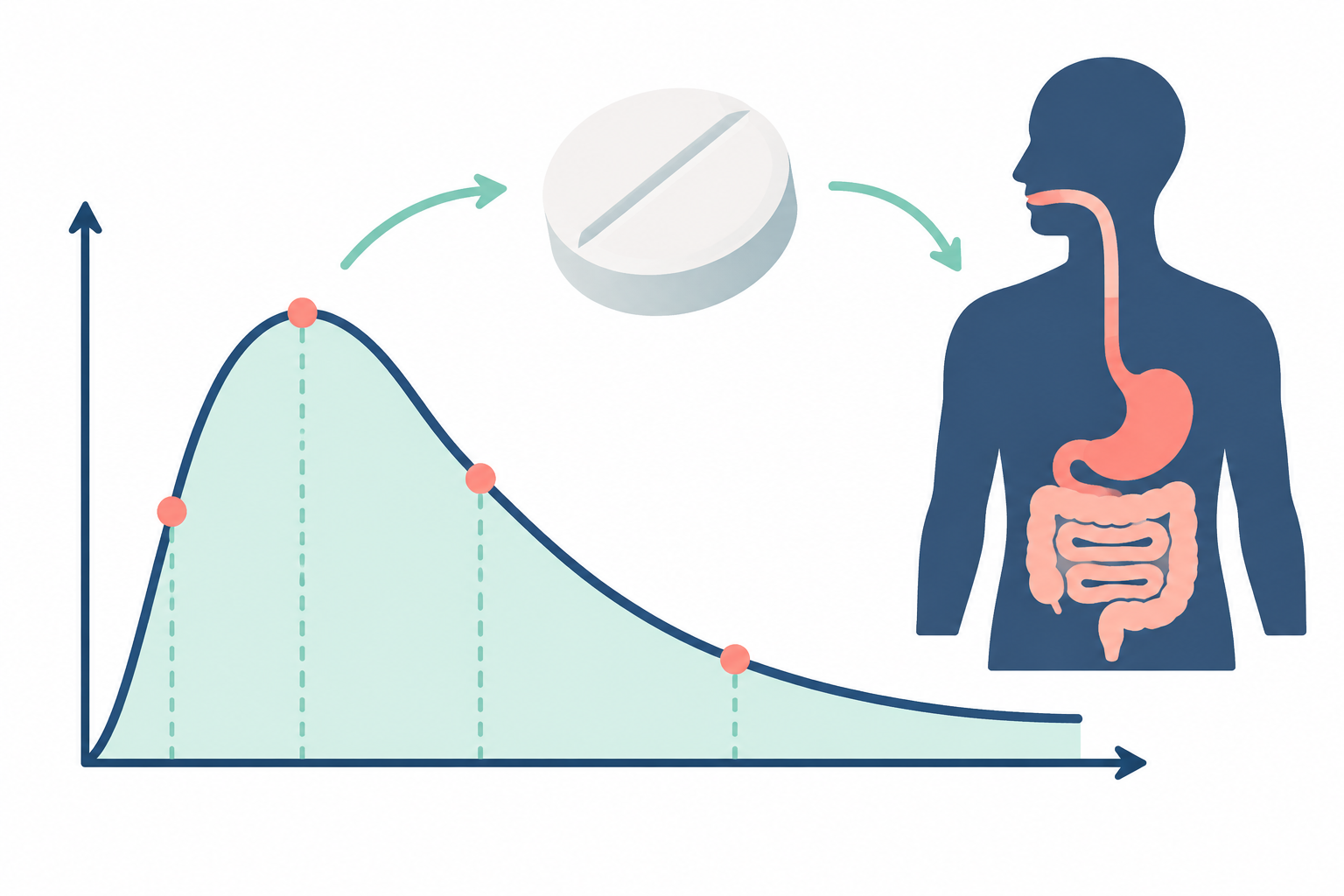
This guide explains the key differences between first-order and zero-order drug elimination kinetics. It covers essential formulas, high-yield drug examples, and clinical concepts tested in GPAT and NIPER exams.
Introduction to Drug Elimination Kinetics
Pharmacokinetics describes how the body handles a drug through absorption, distribution, metabolism, and excretion (ADME). Drug elimination refers to the irreversible removal of drug molecules from the body. It occurs mainly via hepatic metabolism and renal excretion.
In competitive exams like GPAT and NIPER, elimination kinetics is a top-scoring topic. Questions test mathematical formulas, rate processes, graphical plots, and drug examples.
Drug elimination primarily follows two distinct rate processes:
- First-order kinetics (linear kinetics)
- Zero-order kinetics (non-linear or saturation kinetics)
What is First-Order Kinetics?
First-order kinetics is the most common elimination process in the human body. More than 95% of therapeutic drugs follow first-order elimination at clinical doses.
Core Characteristics
- Rate of Elimination: The rate of drug elimination is directly proportional to the plasma drug concentration ($C$). As drug concentration rises, the body clears more drug per unit of time.
- Fraction Eliminated: A constant fraction (percentage) of the drug is eliminated per unit time.
- Clearance ($CL$): Total body clearance remains constant regardless of dose.
- Half-life ($t_{1/2}$): Half-life is constant and dose-independent. Giving a larger dose does not change the half-life.
Mathematical Expression
The rate of elimination is written as:
$$\text{Rate} = - \frac{dC}{dt} = k \cdot C$$
Where:
- $k$ is the first-order elimination rate constant (units: $\text{time}^{-1}$, such as $\text{hr}^{-1}$ or $\text{min}^{-1}$).
- $C$ is the plasma drug concentration.
The Half-Life Formula
The relationship between elimination rate constant ($k$) and half-life ($t_{1/2}$) is:
$$t_{1/2} = \frac{0.693}{k}$$
Relating half-life to apparent volume of distribution ($V_d$) and clearance ($CL$):
$$t_{1/2} = \frac{0.693 \times V_d}{CL}$$
Common Examples
- Paracetamol (therapeutic doses)
- Amoxicillin
- Gentamicin
- Digoxin
- Beta-blockers (e.g., Propranolol)
What is Zero-Order Kinetics?
Zero-order kinetics occurs when the metabolic or excretory pathways responsible for drug elimination become saturated. This process is also known as saturation kinetics, dose-dependent kinetics, or capacity-limited elimination.
Core Characteristics
- Rate of Elimination: The rate of elimination is constant. It is independent of the plasma drug concentration.
- Amount Eliminated: A constant amount (milligrams) of the drug is removed per unit of time, regardless of how high the plasma concentration climbs.
- Clearance ($CL$): Clearance decreases as the dose increases because metabolic enzymes work at peak capacity ($V_{max}$).
- Half-life ($t_{1/2}$): Half-life is not constant. It increases as the administered dose increases.
Mathematical Expression
The rate of elimination is expressed as:
$$\text{Rate} = - \frac{dC}{dt} = k_0$$
Where:
- $k_0$ is the zero-order rate constant (units: $\text{concentration} \times \text{time}^{-1}$, such as $\text{mg/L/hr}$).
Common Examples
Students can remember classic zero-order drugs using the mnemonic "W-P-A-T-E":
- Warfarin (at high or toxic doses)
- Phenytoin (shifts to zero-order at normal therapeutic plasma levels of 10-20 mcg/mL)
- Aspirin (salicylates at anti-inflammatory or toxic doses)
- Theophylline (at elevated doses)
- Ethanol (alcohol follows zero-order kinetics at almost all social intake levels)
Comparison: First-Order vs Zero-Order Kinetics
| Parameter | First-Order Kinetics | Zero-Order Kinetics |
|---|---|---|
| Alternative Names | Linear kinetics | Non-linear / Saturation kinetics |
| Rate of Elimination | Proportional to concentration | Constant; independent of concentration |
| Amount Removed | Constant fraction/percentage (%) | Constant absolute amount (mg) |
| Elimination Rate Constant ($k$) | Unit: $\text{hr}^{-1}$ | Unit: $\text{mg} \cdot \text{L}^{-1} \cdot \text{hr}^{-1}$ |
| Half-Life ($t_{1/2}$) | Constant (independent of dose) | Dose-dependent (increases with dose) |
| Clearance ($CL$) | Constant | Decreases with increasing dose |
| Plasma Level vs Dose | Direct linear increase | Disproportionate, steep increase |
| Toxicity Risk | Lower; predictable accumulation | High; small dose increase causes toxicity |
| Clinical Frequency | Common (>95% of drugs) | Rare (Phenytoin, Ethanol, high-dose Aspirin) |
Michaelis-Menten Kinetics and Mixed-Order Elimination
Most enzymes obey Michaelis-Menten kinetics. The elimination rate follows this formula:
$$\text{Rate of Elimination} = \frac{V_{max} \times C}{K_m + C}$$
- $V_{max}$ is the maximum rate of elimination.
- $K_m$ is the Michaelis constant (the plasma concentration at which the elimination rate is half of $V_{max}$).
- $C$ is the plasma concentration.
Two Critical Conditions
-
When $C \ll K_m$ (Low concentration):
- The denominator $(K_m + C)$ simplifies to $K_m$.
- $\text{Rate} = (V_{max} / K_m) \times C$.
- This represents First-Order Kinetics.
-
When $C \gg K_m$ (High concentration):
- The concentration term dwarfs $K_m$, so $(K_m + C)$ simplifies to $C$.
- $\text{Rate} = V_{max}$.
- This represents Zero-Order Kinetics.
Phenytoin is the classic textbook drug showing this transition. At low therapeutic levels, elimination is first-order. Once enzyme saturation occurs near 10-15 mcg/mL, elimination shifts to zero-order. A minor dose increase can quickly produce ataxia, nystagmus, and cognitive dysfunction.
High-Yield Pharmacokinetic Formulas for GPAT
-
Apparent Volume of Distribution ($V_d$): $$V_d = \frac{\text{Dose}}{\text{Plasma Concentration } (C_0)}$$
-
Clearance ($CL$): $$CL = k \times V_d = \frac{0.693 \times V_d}{t_{1/2}}$$
-
Loading Dose ($LD$): $$LD = \frac{V_d \times C_{target}}{F}$$ (Where $F$ is oral bioavailability; $F = 1$ for IV)
-
Maintenance Dose ($MD$): $$MD = \frac{CL \times C_{target} \times \tau}{F}$$ (Where $\tau$ is the dosing interval)
-
Rule of Plateau (Steady State):
- It takes 4 to 5 half-lives to reach steady-state plasma concentration ($C_{ss}$) during continuous drug administration.
- It also takes 4 to 5 half-lives to eliminate >95% of a drug from the body after stopping therapy.
Test Yourself: 5 MCQs
1. Which of the following drugs follows zero-order elimination kinetics even at standard social or low intake levels?
2. If the dose of a drug that follows first-order kinetics is doubled, what happens to its elimination half-life?
3. Under Michaelis-Menten kinetics, drug elimination shifts to first-order when:
4. How many elimination half-lives are required for a drug following first-order kinetics to reach approximately 95% of steady-state concentration?
5. What are the correct units for the zero-order rate constant (k0)?
Take Free Test on this Topic
Check what you learned with quick GPAT-style questions.
Start Free Test →Unlock all 14 Classifications and 50+ Mock Tests with our Student Pro plan.
Unlock NowFor educational use only — not medical advice. Always check doses with current prescribing information.