DrugClass
Human Body & Drugs
Human Skin and Dermatology Drugs: Study Guide for GPAT
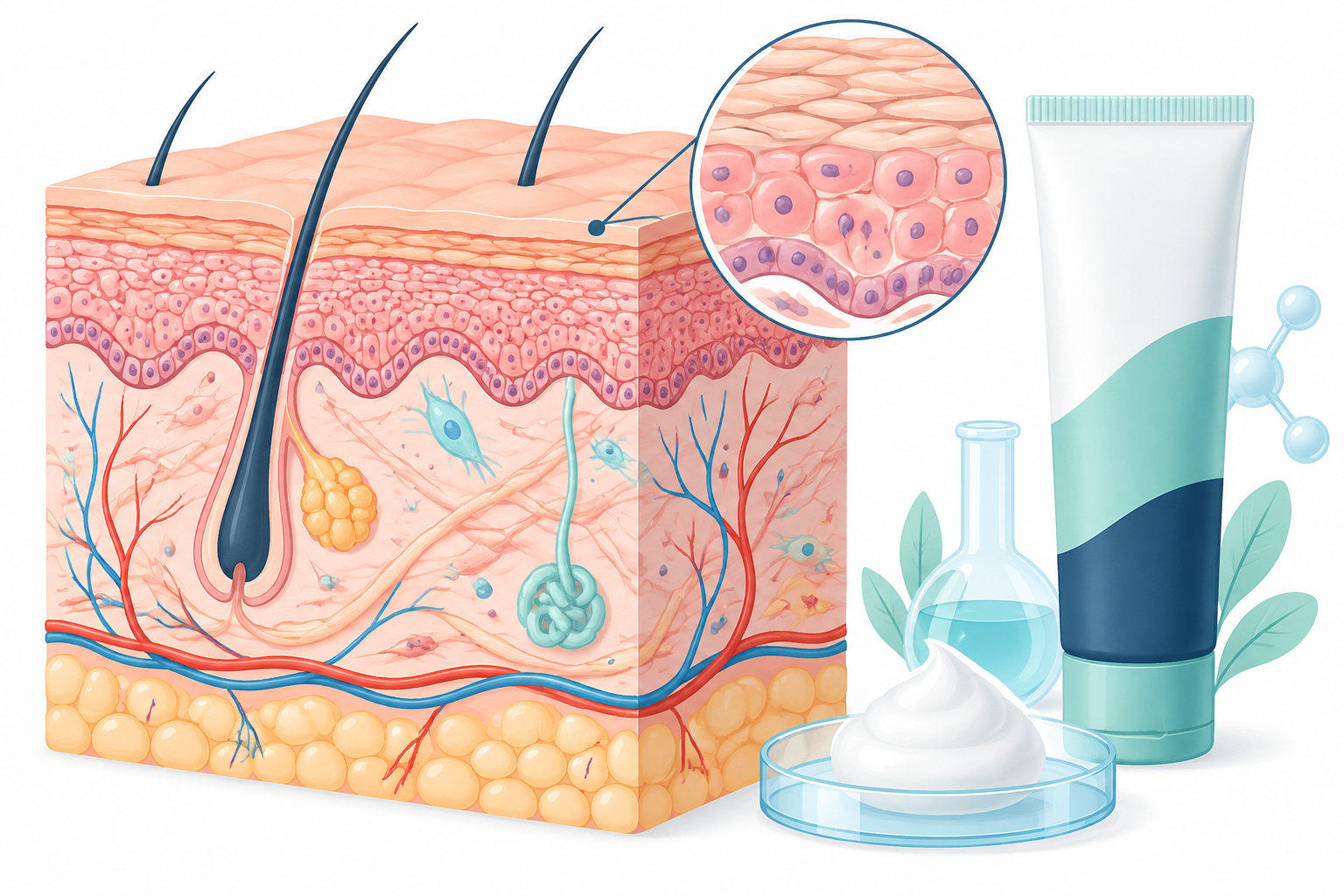
Human skin serves as the primary barrier against the external environment. Dermatology drugs include topical steroids, retinoids, antifungals, and keratolytics that treat various skin conditions. This guide reviews skin anatomy, key drug classes, mechanisms, and GPAT questions.
What is it?
The human skin is the largest organ of the human body. It acts as a protective shield against microbes, chemicals, and physical injury. It also prevents water loss and helps control body temperature.
Skin has three primary layers:
- Epidermis: The outermost layer. It contains keratinocytes, melanocytes, and Langerhans cells.
- Dermis: The middle layer. It contains collagen, elastin, blood vessels, nerve endings, and hair follicles.
- Hypodermis (Subcutis): The deepest layer. It consists of fat tissue and connective tissue.
Dermatology drugs are medicines used to treat skin disorders. These disorders include acne, psoriasis, fungal infections, eczema, and dermatitis. Routes of administration can be topical or systemic.
Salt and Composition
Dermatology uses several distinct chemical classes. Here are the most common salts, strengths, and brand names:
- Hydrocortisone (Topical Corticosteroid):
- Common Strengths: 0.5% w/w, 1% w/w cream or ointment.
- Brand Examples: Cortizone, Locoid.
- Tretinoin (All-trans Retinoic Acid):
- Common Strengths: 0.025% w/w, 0.05% w/w, 0.1% w/w cream or gel.
- Brand Examples: Retin-A, A-Ret.
- Clotrimazole (Azole Antifungal):
- Common Strengths: 1% w/w cream, lotion, or dusting powder.
- Brand Examples: Candid, Lotrimin.
- Salicylic Acid (Beta-Hydroxy Acid / Keratolytic):
- Common Strengths: 2% w/w to 6% w/w ointment, face wash, or solution.
- Brand Examples: Salicylix, Sebogel.
- Clobetasol Propionate (Super-potent Corticosteroid):
- Common Strengths: 0.05% w/w cream or ointment.
- Brand Examples: Tenovate, Dermovate.
Dose Chart
| Drug / Form | Adult Dose | Child Dose |
|---|---|---|
| Hydrocortisone 1% Cream | Apply a thin film 2 to 3 times daily | Apply a thin film 1 to 2 times daily (short duration) |
| Tretinoin 0.025% Gel | Apply a pea-sized amount once daily at bedtime | Not recommended under 12 years |
| Clotrimazole 1% Cream | Apply to affected area 2 times daily for 2 to 4 weeks | Apply to affected area 2 times daily for 2 to 4 weeks |
| Salicylic Acid 6% Ointment | Apply once daily to hyperkeratotic lesions | Use lower strength (1-2%) under medical supervision |
| Clobetasol Propionate 0.05% Cream | Apply thinly 1 to 2 times daily (max 50 g/week) | Not recommended for children under 12 years |
How it Works in the Human Body
Skin drugs enter the body through percutaneous absorption. The drug must cross the skin layers to reach its target site.
-
Passage through the Barrier: The stratum corneum is the top layer of the epidermis. It consists of dead, flat keratin cells surrounded by lipid matrices. This structure works like bricks and mortar. It is the main rate-limiting barrier for drug entry.
-
Keratolytic Action (Salicylic Acid): Salicylic acid lowers skin pH. It dissolves the intracellular cement that binds corneocytes together. This causes shedding of the outer stratum corneum. It softens thick plaques in psoriasis and unblocks pores in acne.
-
Anti-inflammatory Action (Corticosteroids): Hydrocortisone and Clobetasol pass into cell cytoplasm. They bind to glucocorticoid receptors. The drug-receptor complex enters the cell nucleus. It blocks the transcription of pro-inflammatory cytokines (like IL-1, IL-6) and suppresses phospholipase A2. This reduces swelling, redness, and itching.
-
Cell Turnover Regulation (Tretinoin): Tretinoin binds to nuclear Retinoic Acid Receptors (RAR). It stimulates cell division in follicular epithelial cells. This process pushes out microcomedones and stops new acne lesions from forming.
-
Ergosterol Inhibition (Clotrimazole): Clotrimazole inhibits fungal cytochrome P450 enzyme 14-alpha demethylase. This stops the conversion of lanosterol to ergosterol. The fungal membrane becomes permeable and leaks vital nutrients, causing cell death.
Side Effects
- Local Skin Thinning (Atrophy): Prolonged use of potent topical steroids damages collagen synthesis.
- Telangiectasia: Visible, enlarged small blood vessels on the skin surface.
- Striae (Stretch Marks): Common with long-term steroid use in flexural folds.
- Erythema and Peeling: Common with tretinoin and salicylic acid during initial therapy.
- Photosensitivity: Increased sensitivity to UV light, especially with topical retinoids.
- Contact Dermatitis: Burning, itching, or allergic sensitization at the application site.
- Systemic Absorption: High doses of super-potent steroids over large body areas can suppress the hypothalamic-pituitary-adrenal (HPA) axis.
3 Important Exam Points for GPAT
- Stratum Corneum is the Main Barrier: The stratum corneum is the rate-limiting step in percutaneous drug absorption. Hydration of this layer increases drug penetration.
- Potency Classification of Steroids: Clobetasol propionate is a Class I (super-potent) topical steroid. Hydrocortisone is a Class VII (low-potency) steroid.
- Keratolytic Mechanism of Salicylic Acid: Salicylic acid acts by solubilizing the intercellular cement and desmosomes. At high concentrations (>6%), it is destructive to tissues; at low concentrations (1–2%), it acts as a mild keratoplastic agent.
3 MCQs
Which layer of the human epidermis acts as the primary rate-limiting barrier for transdermal drug delivery?
A) Stratum basale
B) Stratum spinosum
C) Stratum corneum
D) Stratum lucidum
Answer: C
Which topical agent acts by binding to nuclear Retinoic Acid Receptors (RAR) to normalize follicular keratinization?
A) Benzoyl peroxide
B) Tretinoin
C) Permethrin
D) Clotrimazole
Answer: B
Prolonged application of high-potency topical corticosteroids on large surface areas can lead to:
A) Hypercalcemia
B) Hypothalamic-pituitary-adrenal (HPA) axis suppression
C) Skin hyperpigmentation
D) Increased dermal collagen synthesis
Answer: B
FAQs
Why should topical retinoids be applied only at night?
Retinoids degrade quickly in sunlight and cause phototoxicity. Applying them at bedtime minimizes drug breakdown and protects sensitized skin from sunburn.
What is the Fingertip Unit (FTU) method?
One Fingertip Unit is the amount of ointment or cream squeezed from a standard tube onto the tip of an adult index finger. One FTU equals about 0.5 grams and covers two adult hand surfaces.
Why are fluorinated steroids avoided on the face?
Fluorinated steroids like clobetasol cause rapid skin thinning, perioral dermatitis, and visible spider veins (telangiectasia) on delicate facial skin.
Take Free Test on this Topic
Check what you learned with quick GPAT-style questions.
Start Free Test →Unlock all 14 Classifications and 50+ Mock Tests with our Student Pro plan.
Unlock NowFor educational use only — not medical advice. Always check doses with current prescribing information.