Kidney Pharmacology: How Common Kidney Drugs Work
The kidneys filter blood and balance water, salts, and acid. Diuretics act at different parts of the nephron to remove extra salt and water. ACE inhibitors, ARBs, certain SGLT2 inhibitors, and finerenone can protect the kidneys in suitable patients. Kidney function, potassium levels, and drug interactions need careful checks.
Your kidneys do much more than make urine. They clean your blood, balance salts, and help control blood pressure. Many common drugs change how the kidneys work. Others protect them from damage. This guide explains kidney pharmacology in simple steps for B.Pharm, D.Pharm, Pharm.D, and GPAT students.
What Do the Kidneys Do?
Most people have two kidneys. These bean-shaped organs sit near the back of the belly, on either side of the spine.
Their main jobs are to:
- Remove waste and extra water from blood.
- Balance salts, such as sodium and potassium.
- Keep the right acid level in the blood.
- Help control blood pressure.
- Make erythropoietin, a hormone that helps the body make red blood cells.
- Activate vitamin D, which supports healthy bones.
When kidney function falls, waste and fluid may build up. Potassium can also rise to unsafe levels. Kidney disease may cause few signs at first, so blood and urine tests matter.
Meet the Nephron: The Kidney’s Working Unit
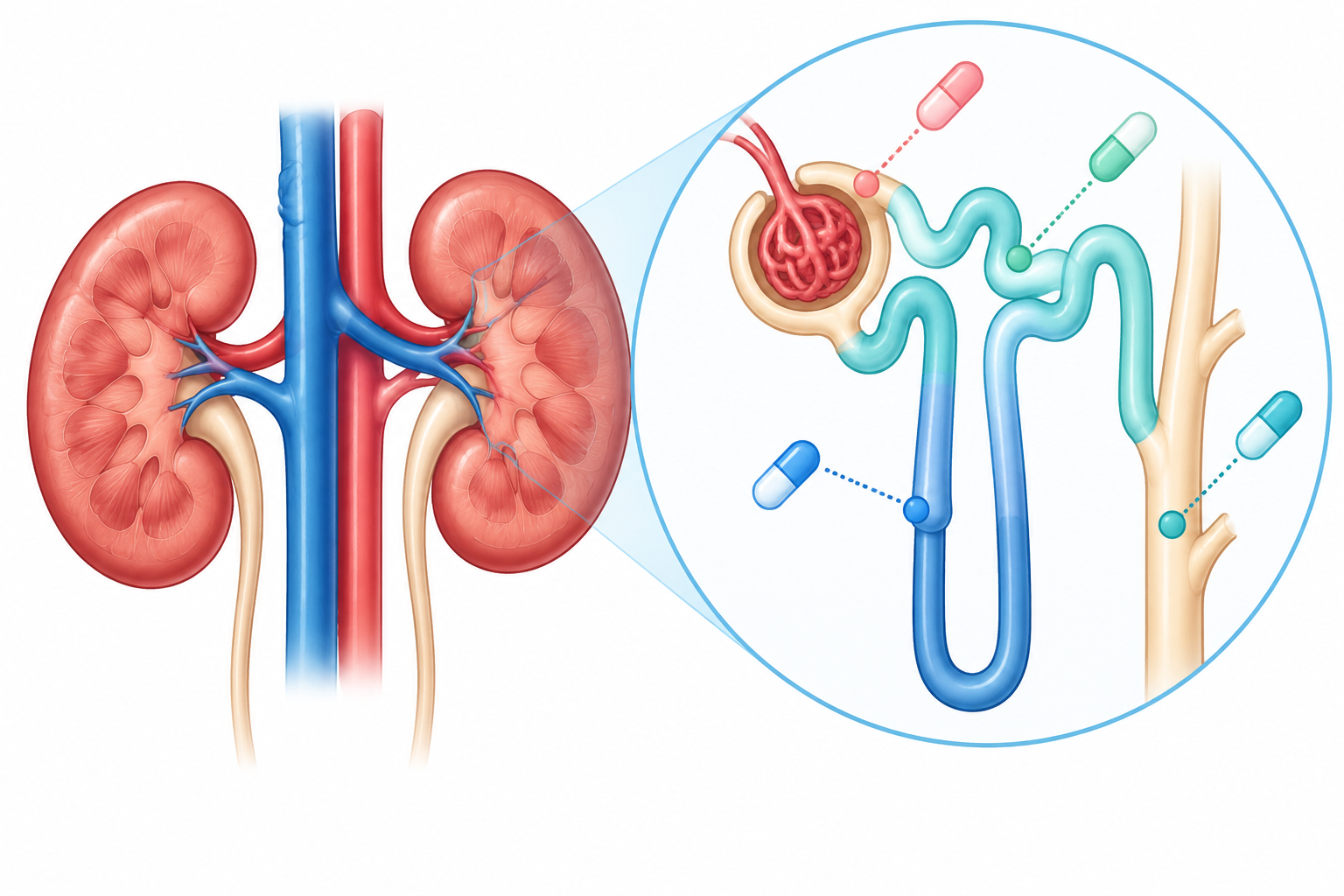
Each kidney has about one million tiny working units called nephrons. Each nephron filters blood and then adjusts what leaves the body in urine.
The glomerulus
This is a tiny bundle of blood vessels. It filters water and small substances from blood. Blood cells and most proteins normally stay in the bloodstream.
The kidney tubule
The filtered fluid then flows through a long tube. The main parts are:
- Proximal tubule: Takes back most filtered salt and water. It also takes back nearly all glucose under normal conditions.
- Loop of Henle: Helps the kidney make concentrated urine.
- Distal tubule: Fine-tunes salt balance.
- Collecting duct: Makes final changes to water, sodium, and potassium levels.
Many kidney drugs act at one of these sites. Knowing the site helps you predict the drug’s effects.
Diuretics: Drugs That Increase Urine Output
Diuretics help the body remove extra salt and water. They are used for high blood pressure and fluid buildup. However, they do not repair damaged kidney tissue.
Loop diuretics
Examples: Furosemide, bumetanide, and torsemide.
These drugs act in the thick ascending part of the loop of Henle. They block a transporter called NKCC2, which normally moves sodium, potassium, and chloride out of the tubule.
More salt stays in the tubule, so more water leaves in urine.
Loop diuretics are useful when a person has major fluid buildup, such as swelling from heart failure.
Important risks include:
- Low potassium.
- Dehydration and low blood pressure.
- Low magnesium.
- Hearing problems, especially with high doses or rapid intravenous use.
Exam point: Loop diuretics increase calcium loss in urine.
Thiazide and thiazide-like diuretics
Examples: Hydrochlorothiazide, chlorthalidone, and indapamide.
These drugs act in the distal tubule. They block the sodium-chloride transporter, called NCC.
They are widely used to treat high blood pressure. Key risks include low sodium, low potassium, and higher uric acid levels. Higher uric acid may trigger gout in some people.
Exam point: Unlike loop diuretics, thiazides reduce calcium loss in urine.
Potassium-sparing diuretics
These drugs act mainly in the late distal tubule and collecting duct. They help the body keep potassium.
There are two main groups:
- Amiloride and triamterene: Block sodium channels called ENaC.
- Spironolactone and eplerenone: Block the action of aldosterone, a hormone that promotes sodium retention and potassium loss.
Their main shared risk is high potassium, also called hyperkalemia. Spironolactone can also cause breast tenderness or breast growth in men.
ACE Inhibitors and ARBs: Lowering Pressure Inside the Filter
The kidneys help control blood pressure through the renin-angiotensin-aldosterone system, or RAAS.
This system makes blood vessels tighten and tells the body to retain salt and water.
Two important drug groups reduce its effects:
- ACE inhibitors: Examples include ramipril, lisinopril, and enalapril.
- ARBs: Examples include losartan, valsartan, and telmisartan.
These drugs relax the blood vessel that carries blood away from the glomerulus. This lowers pressure inside the kidney filter.
They can reduce protein leakage into urine and slow kidney damage in suitable patients, especially those with albumin in their urine.
What should be checked?
Blood pressure, serum creatinine, and potassium need monitoring after treatment starts or the dose rises. Creatinine is a blood marker used to help estimate kidney function.
A small rise in creatinine may occur. A larger rise needs review for causes such as dehydration or poor blood flow to the kidneys.
Important safety points:
- ACE inhibitors may cause a dry cough.
- ACE inhibitors can rarely cause serious swelling called angioedema.
- Both groups can raise potassium.
- Both should be avoided during pregnancy.
- ACE inhibitors and ARBs should not routinely be used together.
SGLT2 Inhibitors: More Than Diabetes Drugs
Examples: Dapagliflozin and empagliflozin.
These drugs block SGLT2, a protein in the proximal tubule that takes glucose and sodium back into the blood. Blocking it lets more glucose leave through urine.
Their role now goes well beyond blood sugar control. Certain SGLT2 inhibitors can slow chronic kidney disease and reduce heart failure events in suitable patients. Some people benefit even without diabetes.
They also help lower excess pressure inside the kidney filter.
Key risks and checks
- Genital yeast infections can occur.
- Fluid loss may cause dizziness or low blood pressure.
- Rarely, diabetic ketoacidosis can occur even when blood sugar is not very high.
Kidney function and the reason for treatment guide their use. A small early fall in estimated kidney filtration rate, or eGFR, may occur and does not always mean kidney injury.
Patients need a clear plan for surgery, fasting, or serious illness, when temporary pauses may be needed.
Finerenone: Blocking Harmful Aldosterone Effects
Finerenone is a nonsteroidal mineralocorticoid receptor antagonist. It blocks aldosterone’s action and helps reduce inflammation and scarring linked to kidney damage.
It can lower the risk of kidney and heart problems in eligible adults with chronic kidney disease linked to type 2 diabetes.
It is not mainly used to remove large amounts of extra fluid. High potassium is an important risk, so potassium and kidney function must be checked.
Kidney Drug Safety: What Pharmacy Students Should Remember
Kidneys clear many drugs from the body. Poor kidney function may require a lower dose or a longer gap between doses.
Also watch for the “triple whammy”: an ACE inhibitor or ARB, a diuretic, and an NSAID painkiller such as ibuprofen. This mix raises the risk of acute kidney injury, especially during dehydration.
Avoid assuming that all kidney medicines do the same job. Some remove fluid, some lower pressure, and some slow long-term damage. Treatment depends on kidney tests, potassium levels, other diseases, and the patient’s full medicine list.
Take Free Test on this Topic
Check what you learned with quick GPAT-style questions.
Start Free Test →Unlock 500 Blogs for ₹199
Unlock NowFor educational use only — not medical advice. Always check doses with current prescribing information.