Proton Pump Inhibitors: Drug Dose Chart and GPAT Notes
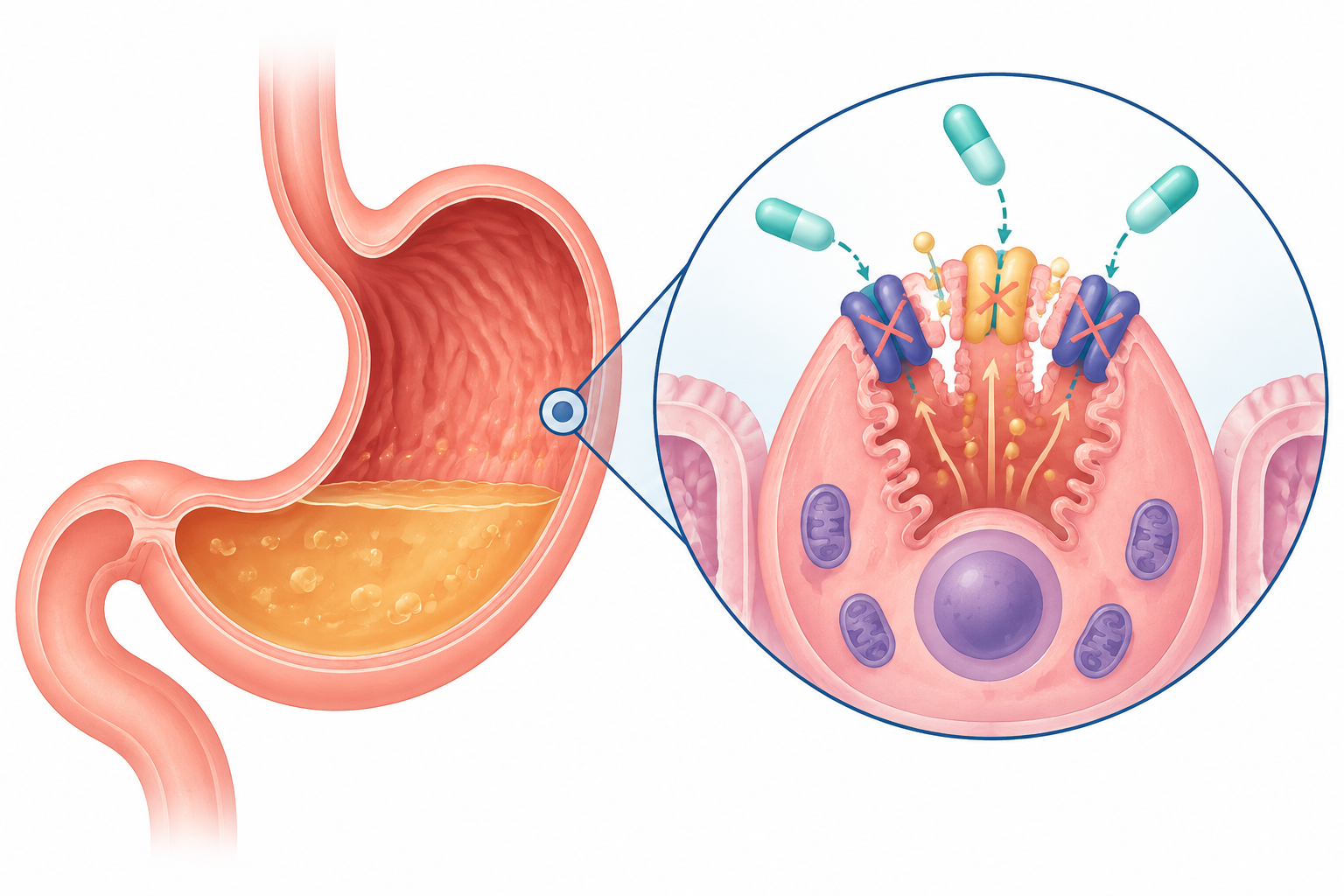
Proton pump inhibitors reduce stomach acid by blocking H+/K+-ATPase in parietal cells. Review their standard doses, important side effects, and key GPAT concepts with three practice MCQs.
What is it?
Proton pump inhibitors, or PPIs, are medicines that reduce stomach acid. Common examples are omeprazole, pantoprazole, and esomeprazole. They are important drugs in gastrointestinal pharmacology for B.Pharma, D.Pharma, and GPAT students.
The stomach needs acid to help digest food. Acid also helps protect the body from some swallowed germs. However, acid can injure tissues when normal protective mechanisms fail.
Doctors use PPIs for:
- Gastro-oesophageal reflux disease, or GERD.
- Erosive oesophagitis, where reflux damages the food pipe.
- Gastric and duodenal ulcers.
- Prevention of NSAID-related ulcers in selected high-risk patients.
- Zollinger–Ellison syndrome, which causes excessive acid production.
PPIs also form part of treatment for Helicobacter pylori infection. They must be combined with suitable antibiotics. A PPI alone does not remove this infection.
Dose Chart
These are standard oral doses for healing erosive oesophagitis. Doses for other conditions may differ. All doses below are taken once daily. The chart is for study, not self-prescribing.
| Drug / Form | Adult Dose | Child Dose |
|---|---|---|
| Omeprazole, delayed-release capsule or suitable granules | 20 mg once daily for 4–8 weeks | Ages 1–16 years: 5 to under 10 kg: 5 mg daily; 10 to under 20 kg: 10 mg daily; 20 kg or more: 20 mg daily. Usually 4–8 weeks. |
| Pantoprazole, delayed-release tablet or suitable granules | 40 mg once daily for up to 8 weeks | Age 5 years or older: 15 to under 40 kg: 20 mg daily; 40 kg or more: 40 mg daily. Up to 8 weeks. |
| Esomeprazole, delayed-release capsule or suitable granules | 20 or 40 mg once daily for 4–8 weeks | Ages 1–11 years: under 20 kg: 10 mg daily; 20 kg or more: 10 or 20 mg daily. Treat for 8 weeks. Ages 12–17 years: 20 or 40 mg daily for 4–8 weeks. |
Practical dose notes:
- Child doses depend on age, weight, indication, and product approval.
- Do not apply these doses to infants or children outside the listed groups.
- Use a formulation that can deliver the prescribed dose accurately.
- Do not crush or chew delayed-release tablets or coated granules.
- Some capsules can be opened. Follow that product’s mixing instructions.
- Liver disease may require a lower dose, depending on the drug.
Longer treatment needs review. Use the lowest effective dose for the required duration.
How it Works
Parietal cells in the stomach lining produce acid. Their surface contains the H+/K+-ATPase, also called the proton pump. This pump exchanges hydrogen ions for potassium ions. It performs the final step in acid secretion.
PPIs block this final step.
- The protective formulation helps the drug pass through the acidic stomach.
- The drug is absorbed in the small intestine.
- Blood carries it to the parietal cells.
- It enters their highly acidic secretory canaliculi.
- The PPI becomes active and binds to working proton pumps.
- Acid secretion falls until functional pumps become available again.
PPIs are prodrugs. Their active forms inhibit the pump irreversibly by forming covalent bonds. This explains why acid suppression lasts much longer than their short plasma half-life.
They do not neutralise acid already present. Antacids do that. PPIs reduce the production of new acid.
Full acid suppression usually takes several days of regular dosing. Not every pump is active when the first dose reaches the stomach.
Most PPIs work best before a meal. A common timing is 30–60 minutes before breakfast. Esomeprazole instructions specify at least one hour before food. Product instructions differ; pantoprazole tablets, for example, may be taken with or without food.
Side Effects
Common side effects include:
- Headache.
- Nausea.
- Abdominal discomfort.
- Diarrhoea or constipation.
- Gas.
Important but less common concerns include low magnesium, especially with prolonged use, and reduced vitamin B12 absorption during long-term treatment. Acute tubulointerstitial nephritis is a rare but serious kidney reaction.
PPI use is associated with some intestinal infections, including Clostridioides difficile. Long-term or high-dose use is also associated with a higher fracture risk. These associations do not mean every user will develop these problems.
Omeprazole and esomeprazole inhibit CYP2C19. They can reduce activation of clopidogrel. Avoid this combination unless a prescriber has assessed it and selected suitable treatment.
Seek medical care for vomiting blood, black stools, trouble swallowing, or unexplained weight loss. Acid suppression should not delay investigation of these warning signs.
3 Important Exam Points for GPAT
- Target: PPIs inhibit H+/K+-ATPase in gastric parietal cells. This is the final common step in acid secretion.
- Activation: PPIs are acid-activated prodrugs. Their active forms bind irreversibly to the pump, giving prolonged action despite a short plasma half-life.
- Comparison: H2 blockers inhibit histamine H2 receptors. PPIs act farther downstream and generally produce stronger acid suppression.
3 MCQs
1. Which enzyme is directly inhibited by PPIs?
A. Cyclo-oxygenase
B. H+/K+-ATPase
C. Acetylcholinesterase
D. Carbonic anhydrase
Answer: B
2. Why does omeprazole act longer than its plasma half-life?
A. It neutralises all existing stomach acid.
B. It permanently blocks histamine production.
C. It binds irreversibly to proton pumps.
D. It remains in the intestine for several weeks.
Answer: C
3. Which drug may have reduced activation with omeprazole?
A. Clopidogrel
B. Paracetamol
C. Amoxicillin
D. Salbutamol
Answer: A
FAQs
Are PPIs the same as antacids?
No. Antacids neutralise existing acid. PPIs reduce acid production and are not ideal for immediate symptom relief.
Can a PPI alone cure H. pylori infection?
No. Treatment needs an appropriate combination regimen containing antibiotics. Acid suppression supports healing and antibiotic activity.
Can PPIs be stopped after long-term use?
Some people develop temporary rebound acid symptoms after stopping. A clinician can review the indication and plan dose reduction or withdrawal when appropriate.
Take Free Test on this Topic
Check what you learned with quick GPAT-style questions.
Start Free Test →Unlock 500 Blogs for ₹199
Unlock NowFor educational use only — not medical advice. Always check doses with current prescribing information.