DrugClass
Human Body & Drugs
Human Brain and Neurological Drugs: GPAT Pharmacology Guide
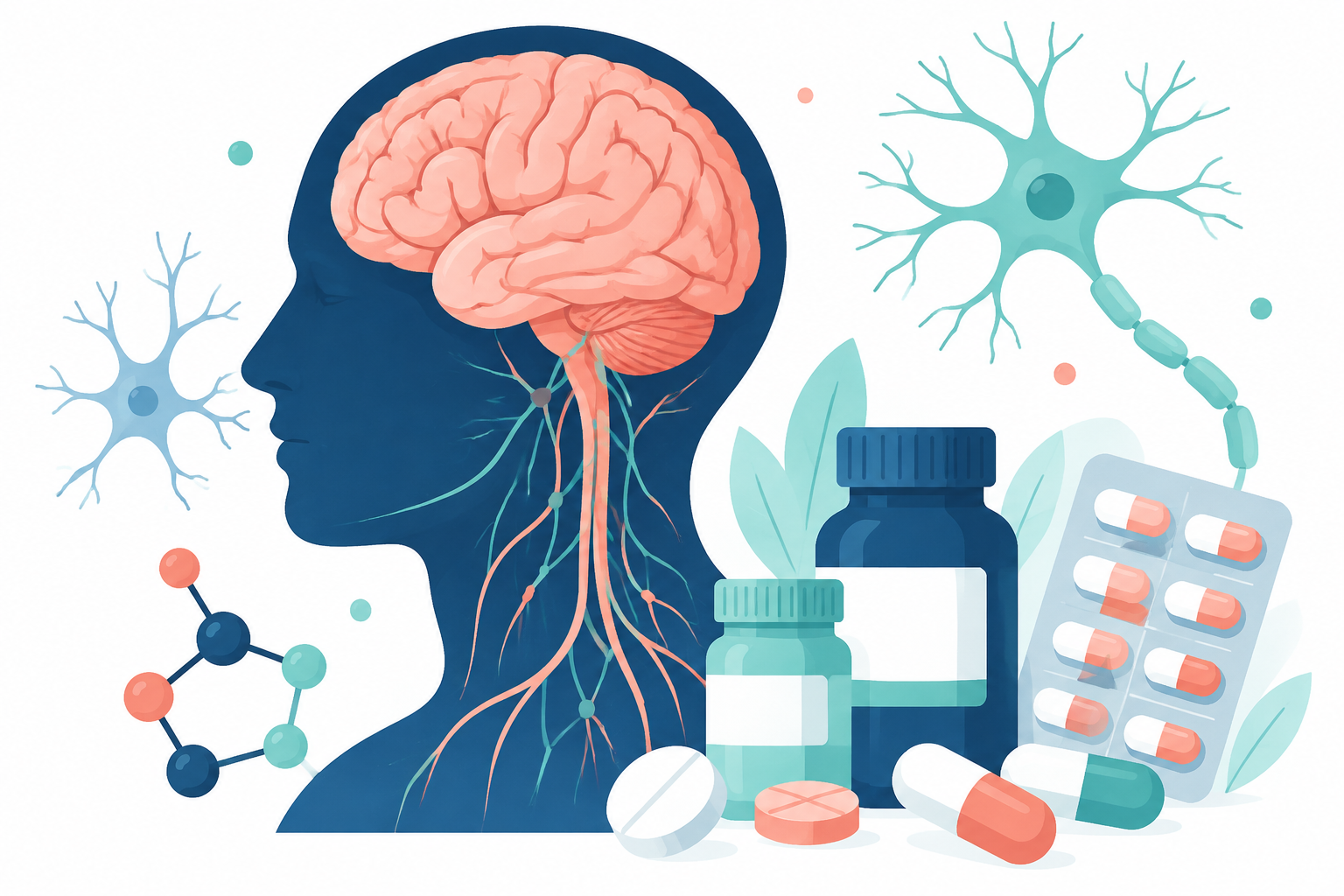
This guide covers the human brain and major neurological drugs for pharmacy students. It details drug mechanisms, standard doses, side effects, and GPAT exam points. Master essential CNS pharmacology concepts with simple notes and practice questions.
What is it?
The human brain is the control center of the nervous system. It contains billions of nerve cells called neurons. Neurons communicate with each other using chemical messengers called neurotransmitters. Important neurotransmitters include dopamine, gamma-aminobutyric acid (GABA), acetylcholine, serotonin, and glutamate.
Neurological disorders happen when neurotransmitter levels become abnormal or when neurons get damaged. Common brain disorders include epilepsy, Parkinson's disease, anxiety, and stroke.
Neurological drugs are chemical substances that act on the central nervous system (CNS). They can cross the protective blood-brain barrier (BBB). These drugs help balance brain chemicals, stop abnormal electrical firing, or replace missing neurotransmitters. They help restore normal brain function and improve quality of life.
Salt and Composition
Neurological drugs fall into many therapeutic classes. Here are three key standard drugs studied in pharmacy:
-
Phenytoin Sodium
- Salt Form: Sodium salt of diphenylhydantoin.
- Common Strengths: 50 mg, 100 mg tablets and capsules; 50 mg/mL injectable solution.
- Brand Examples: Dilantin, Eptoin.
-
Levodopa + Carbidopa
- Salt Form: Fixed-dose combination of L-dopa (metabolic precursor of dopamine) and carbidopa monohydrate (peripheral dopa decarboxylase inhibitor).
- Common Strengths: 100 mg Levodopa + 10 mg Carbidopa (10:1 ratio); 250 mg Levodopa + 25 mg Carbidopa (10:1 ratio); 100 mg Levodopa + 25 mg Carbidopa (4:1 ratio).
- Brand Examples: Syndopa, Sinemet.
-
Diazepam
- Salt Form: 7-chloro-1,3-dihydro-1-methyl-5-phenyl-2H-1,4-benzodiazepin-2-one (free base).
- Common Strengths: 2 mg, 5 mg, 10 mg oral tablets; 5 mg/mL injection; 5 mg/mL rectal gel.
- Brand Examples: Valium, Calmpose.
Dose Chart
| Drug / Form | Adult Dose | Child Dose |
|---|---|---|
| Phenytoin Sodium (Oral Tablets/Capsules) | 300 mg to 400 mg daily in divided doses (maintenance) | 5 mg/kg/day divided into 2 or 3 doses (max 300 mg/day) |
| Levodopa + Carbidopa (Oral Tablets, 100/25 mg) | 1 tablet three times daily initially; titrated up to 8 tablets daily | Not recommended for children under 18 years |
| Diazepam (Oral Tablets for Anxiety) | 2 mg to 10 mg taken 2 to 4 times daily | 1 mg to 2.5 mg taken 3 to 4 times daily (for children older than 6 months) |
| Diazepam (IV Injection for Status Epilepticus) | 5 mg to 10 mg slow IV push (rate: 5 mg/min; repeat every 10–15 min, max 30 mg) | 0.2 mg to 0.5 mg/kg slow IV push every 2–5 min (max 5 mg if <5 yrs; max 10 mg if >=5 yrs) |
How it Works in the Human Body
Neurological drugs act on distinct parts of the central nervous system through specific steps:
1. Crossing the Blood-Brain Barrier (BBB)
- The brain is protected by tight capillary endothelial cells called the BBB.
- Lipid-soluble drugs like diazepam cross this barrier directly by passive diffusion.
- Large polar molecules like dopamine cannot cross. However, its amino acid precursor, Levodopa, enters the brain using the L-type neutral amino acid transporter (LAT1).
2. Receptor Binding and Ion Channel Modulation
- Phenytoin: It binds to voltage-gated sodium channels on the neuronal membrane in their inactive state. It prolongs channel inactivation. This action blocks high-frequency, repetitive neuronal firing during a seizure.
- Levodopa and Carbidopa: In peripheral tissues, carbidopa blocks the enzyme dopa decarboxylase. This stops Levodopa from breaking down outside the brain. Levodopa then crosses into the basal ganglia. Here, central dopa decarboxylase converts Levodopa into active dopamine. This restores dopamine levels in the striatum to treat Parkinson's disease.
- Diazepam: It binds to an allosteric site on the GABA-A receptor complex. This increases the opening frequency of the central chloride ion channel. Chloride ions enter the neuron and hyperpolarize the cell. This reduces neuronal excitability, producing calming and muscle-relaxing effects.
Side Effects
Neurological drugs have narrow safety windows and cause distinct adverse reactions:
Phenytoin
- Gingival hyperplasia: Swelling and overgrowth of gum tissue.
- CNS effects: Nystagmus (involuntary eye movement), ataxia (loss of balance), and vertigo.
- Cosmetic changes: Hirsutism (excessive body hair) and coarse facial features.
- Hematologic effects: Megaloblastic anemia due to altered folate metabolism.
- Teratogenic risk: Fetal hydantoin syndrome.
Levodopa + Carbidopa
- Motor complications: Dyskinesias (involuntary muscle twitches) and "on-off" fluctuations.
- Cardiovascular effects: Postural hypotension and cardiac arrhythmias.
- Gastrointestinal effects: Nausea and vomiting due to stimulation of the chemoreceptor trigger zone (CTZ).
- Psychiatric symptoms: Vivid dreams, hallucinations, and confusion.
Diazepam
- Sedation: Marked daytime drowsiness, fatigue, and reduced motor coordination.
- Tolerance and dependence: Physical addiction with withdrawal symptoms upon sudden stoppage.
- Respiratory depression: Shallow breathing, especially when combined with alcohol or opioids.
- Retrograde and anterograde amnesia: Short-term memory gaps.
3 Important Exam Points for GPAT
- Zero-Order Elimination Kinetics of Phenytoin: At low doses, phenytoin follows first-order kinetics. At therapeutic plasma concentrations (10 to 20 mcg/mL), the metabolic liver enzymes become saturated. The drug shifts to zero-order (saturation or Michaelis-Menten) kinetics. A small dose increase can lead to sudden toxicity.
- Role of Carbidopa: Carbidopa is a peripheral dopa decarboxylase inhibitor. It cannot cross the blood-brain barrier. It reduces the required dose of Levodopa by nearly 75% and prevents peripheral side effects like nausea and cardiac arrhythmias.
- GABA-A Receptor Mechanism Difference: Benzodiazepines (like diazepam) increase the frequency of GABA-gated chloride channel openings. In contrast, barbiturates increase the duration of channel opening.
3 MCQs
Question 1
Which adverse effect is characteristically linked with long-term phenytoin therapy in young patients? A) Gingival hyperplasia B) Pulmonary fibrosis C) Gray baby syndrome D) Retinal detachment
Answer: A
Question 2
Why is Carbidopa administered together with Levodopa in the treatment of Parkinsonism? A) It directly activates central dopamine D2 receptors B) It prevents peripheral metabolism of Levodopa C) It speeds up the renal excretion of toxic metabolites D) It helps Levodopa bind to plasma albumin
Answer: B
Question 3
Benzodiazepines like Diazepam produce their central inhibitory actions by increasing which property of chloride channels? A) Opening duration B) Conductance voltage C) Opening frequency D) Inactivation rate
Answer: C
FAQs
Why does dopamine itself not work as an oral drug for Parkinson's disease?
Dopamine is highly polar and cannot cross the blood-brain barrier. It also gets rapidly metabolized by monoamine oxidase (MAO) and catechol-O-methyltransferase (COMT) in the gut and liver. Levodopa, its precursor, must be used instead.
What is the therapeutic plasma concentration range for Phenytoin?
The standard therapeutic range for phenytoin is 10 to 20 mcg/mL. Levels above 20 mcg/mL cause nystagmus, levels above 30 mcg/mL cause ataxia, and levels above 40 mcg/mL can cause coma and seizures.
Can diazepam be stopped suddenly after long-term use?
No. Sudden discontinuation of diazepam can trigger severe withdrawal symptoms. These include rebound insomnia, intense anxiety, tremors, and life-threatening seizures. The dose must always be tapered down gradually under medical supervision.
Take Free Test on this Topic
Check what you learned with quick GPAT-style questions.
Start Free Test →Unlock all 14 Classifications and 50+ Mock Tests with our Student Pro plan.
Unlock NowFor educational use only — not medical advice. Always check doses with current prescribing information.