DrugClass
GPAT Important Drugs
Phenytoin Drug Dose, Side Effects and GPAT Exam Notes
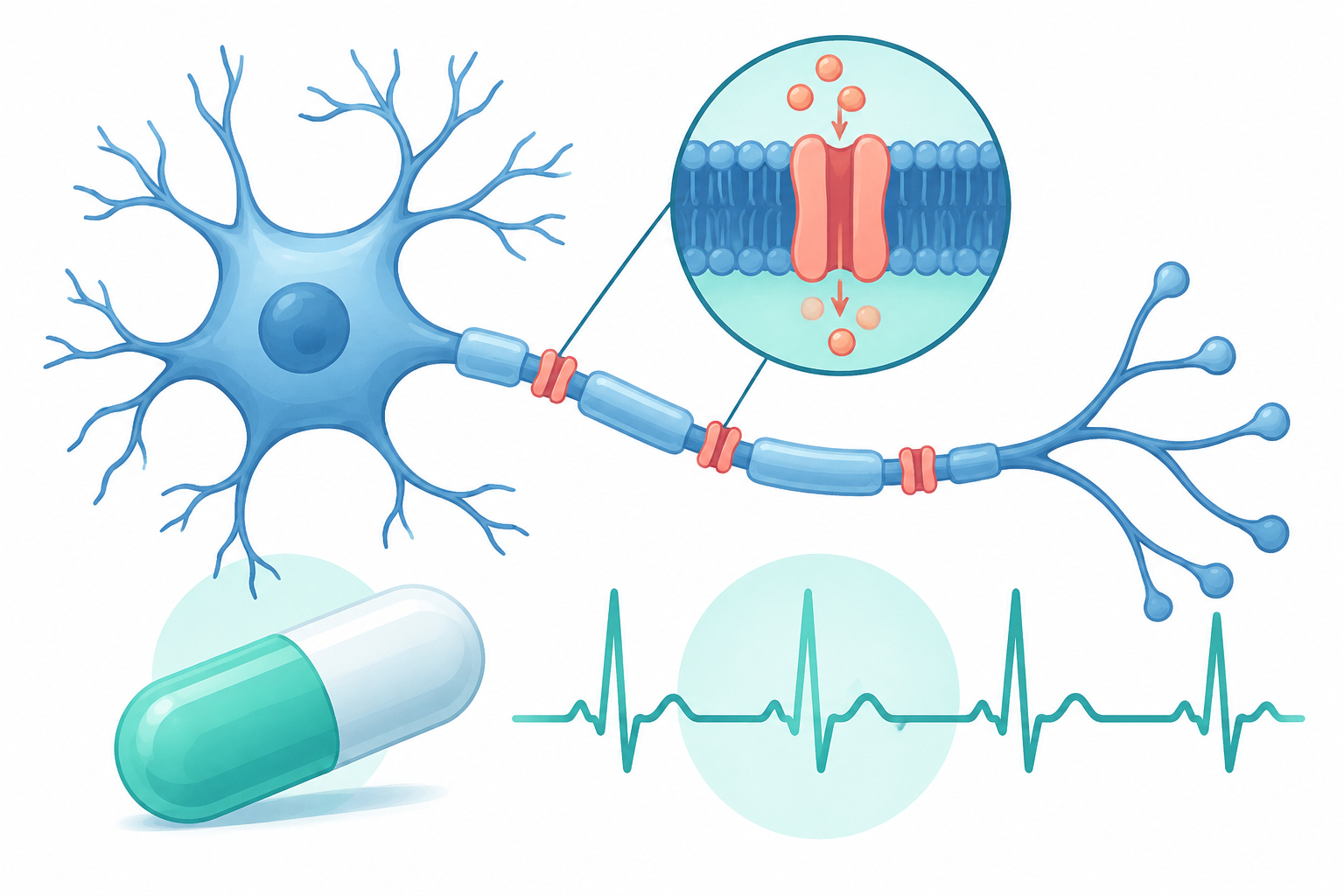
Phenytoin treats focal and tonic–clonic seizures by blocking sodium channels. Revise its standard doses, saturable metabolism, interactions and classic adverse effects for GPAT.
What is it?
Phenytoin is an antiseizure medicine from the hydantoin group. It is used for focal seizures and generalized tonic–clonic seizures. It is an important drug for B.Pharma, D.Pharma and GPAT revision.
A seizure happens when brain cells produce abnormal electrical activity. Phenytoin limits the spread of this activity. It controls seizures but does not cure their underlying cause.
Its main uses include:
- Long-term control of focal and tonic–clonic seizures.
- Treatment of ongoing convulsive status epilepticus after a benzodiazepine, when selected by the treating team.
- Prevention or treatment of seizures around neurosurgery in selected patients.
Phenytoin is not used for absence seizures. It may worsen absence and myoclonic seizures.
It comes as capsules, tablets, oral suspension and an intravenous injection. These forms are not always freely interchangeable. This guide is for study, not for choosing or changing treatment yourself.
Dose Chart
These are standard reference doses. The exact dose depends on seizure control, body weight, blood levels and adverse effects. Loading doses require medical supervision.
| Drug / Form | Adult Dose | Child Dose |
|---|---|---|
| Oral phenytoin: starting treatment | Commonly 100 mg three times daily | Initially 5 mg/kg/day, divided into 2–3 doses |
| Oral phenytoin: maintenance | Usually 300–400 mg/day in divided doses; adjust individually | Usually 4–8 mg/kg/day in divided doses; usual maximum 300 mg/day |
| IV phenytoin: loading for status epilepticus | Usually 15–20 mg/kg under continuous monitoring | Usually 15–20 mg/kg under continuous monitoring |
| IV phenytoin: maximum administration rate | Do not exceed 50 mg/min; slower rates may be needed | Do not exceed 1–3 mg/kg/min or 50 mg/min, whichever is slower |
The last row gives an infusion rate, not a daily dose. Confusing these units is dangerous.
Important administration points:
- Monitor ECG, blood pressure and breathing during IV treatment.
- Use normal saline for IV dilution according to the product instructions. Dextrose solutions can cause precipitation.
- Avoid intramuscular phenytoin because absorption is unreliable and tissue injury can occur.
- Shake oral suspension well. Measure it with an oral syringe.
- Do not stop treatment suddenly. This can trigger seizures.
Phenytoin sodium and free-acid phenytoin contain different amounts of active drug by weight. Switching salts or dosage forms may require dose adjustment and blood-level monitoring.
How it Works
Phenytoin blocks voltage-gated sodium channels in nerve cells. It mainly binds to channels in the inactivated state and delays their recovery.
This reduces repeated, rapid firing of neurons. Its action is use-dependent: rapidly firing cells are affected more strongly than normally firing cells.
Phenytoin also has an important pharmacokinetic feature. Liver enzymes that break it down have a limited capacity. As concentrations rise, these enzymes can become saturated.
Once metabolism approaches saturation, a small dose increase may cause a large rise in blood concentration. This is called nonlinear, capacity-limited kinetics. GPAT questions often describe it as zero-order elimination at higher concentrations.
It is highly bound to albumin. The usual therapeutic range is:
- Total phenytoin: 10–20 micrograms/mL.
- Free phenytoin: 1–2 micrograms/mL.
These ranges support clinical assessment; they do not replace it. Low albumin or kidney disease can increase the free fraction. A total level may then look acceptable even when active drug levels are too high.
Side Effects
Common or dose-related effects include:
- Nystagmus, which means involuntary eye movements.
- Dizziness and double vision.
- Ataxia, or poor balance and coordination.
- Slurred speech and confusion at higher concentrations.
Important effects during long-term use include:
- Gingival overgrowth: enlarged gums. Good oral hygiene and dental care help reduce this problem.
- Hirsutism, meaning increased hair growth.
- Folate deficiency and sometimes megaloblastic anaemia.
- Reduced bone mineral density and osteomalacia.
- Peripheral neuropathy with prolonged exposure.
Serious reactions include severe skin reactions, such as Stevens–Johnson syndrome, and drug reaction with eosinophilia and systemic symptoms, or DRESS. A new rash, fever, facial swelling or mouth sores needs urgent medical assessment.
IV phenytoin may cause hypotension, arrhythmias and local tissue injury. Purple glove syndrome causes painful swelling and purple discoloration near or beyond the injection site.
Phenytoin can harm fetal development. Patients planning pregnancy need specialist review. They should not stop antiseizure treatment without medical advice.
3 Important Exam Points for GPAT
- Mechanism and seizure type: Phenytoin prolongs sodium-channel inactivation. It treats focal and tonic–clonic seizures, not absence seizures.
- Kinetics and monitoring: It shows saturable metabolism. Small dose increases can cause toxicity. Remember the total therapeutic range of 10–20 micrograms/mL and the importance of free levels when protein binding changes.
- Enzyme induction and classic toxicity: Phenytoin induces hepatic drug-metabolizing enzymes. It can reduce the effectiveness of hormonal contraceptives and several other medicines. Gingival overgrowth, hirsutism and nystagmus are classic exam clues.
3 MCQs
1. Phenytoin mainly controls seizures by acting on which target?
A. GABA breakdown enzymes
B. Voltage-gated sodium channels
C. Dopamine receptors
D. Histamine receptors
Answer: B
2. Why can a small phenytoin dose increase cause a large rise in blood level?
A. Its metabolism becomes saturated
B. It is completely excreted unchanged
C. It has no protein binding
D. It blocks its own intestinal absorption
Answer: A
3. Which adverse effect is classically linked to long-term phenytoin treatment?
A. Dry cough
B. Orange urine
C. Gingival overgrowth
D. Tendon rupture
Answer: C
FAQs
Is phenytoin a first-line drug for absence seizures?
No. Ethosuximide is a usual choice for absence-only epilepsy. Phenytoin may worsen absence seizures.
What is the difference between phenytoin and fosphenytoin?
Fosphenytoin is a water-soluble prodrug converted to phenytoin. Its dose is expressed in phenytoin equivalents, or mg PE. It generally causes less local tissue irritation.
Can phenytoin reduce contraceptive effectiveness?
Yes. Enzyme induction can reduce the effectiveness of some hormonal contraceptives. Patients need advice about suitable contraception.
Take Free Test on this Topic
Check what you learned with quick GPAT-style questions.
Start Free Test →Unlock all 14 Classifications and 50+ Mock Tests with our Student Pro plan.
Unlock NowFor educational use only — not medical advice. Always check doses with current prescribing information.