 DrugClass
Amoxicillin Drug Dose, Uses and Key GPAT Exam Points
Amoxicillin is an aminopenicillin that kills susceptible bacteria by blocking cell-wall synthesis. Review its adult and child doses, allergy risks, beta-lactamase resistance and common GPAT calculation traps.
What is it?
Amoxicillin is a penicillin antibiotic. It belongs to the aminopenicillin group. It is a beta-lactam drug because its structure contains a beta-lactam ring.
Doctors use it to treat certain bacterial infections. Common examples include susceptible infections of the ear, throat, respiratory tract, skin and urinary tract. The choice depends on the likely bacteria and local resistance patterns.
Amoxicillin is also used with other medicines to treat Helicobacter pylori infection. It must not be used alone for this purpose.
It does not treat colds, flu or other viral infections. Unnecessary use can cause side effects and increase antibiotic resistance.
For B.Pharma and D.Pharma students, this drug connects several important topics: cell-wall synthesis, penicillin allergy, bacterial resistance and weight-based dosing.
Dose Chart
These are standard oral doses for selected uses. They are study notes, not a prescription. Dose selection depends on the infection, age, weight and kidney function.
| Drug / Form | Adult Dose | Child Dose |
|---|---|---|
| Amoxicillin oral: mild to moderate susceptible ear, nose, throat, skin or urinary infection | 250 mg every 8 hours OR 500 mg every 12 hours | Age over 3 months and weight under 40 kg: 20 mg/kg/day in 3 divided doses OR 25 mg/kg/day in 2 divided doses |
| Amoxicillin oral: severe susceptible infection at these sites, or lower respiratory tract infection | 500 mg every 8 hours OR 875 mg every 12 hours | Age over 3 months and weight under 40 kg: 40 mg/kg/day in 3 divided doses OR 45 mg/kg/day in 2 divided doses |
| Amoxicillin oral: infants aged 3 months or younger | Not applicable | Upper recommended dose: 30 mg/kg/day in 2 divided doses; clinician assessment is essential |
| Amoxicillin oral: infective endocarditis prophylaxis before selected dental procedures | 2 g once, 30–60 minutes before the procedure | 50 mg/kg once, 30–60 minutes before the procedure; maximum 2 g |
Important dose rules:
- Children weighing 40 kg or more generally receive adult doses. Do not exceed the appropriate adult dose when using routine weight-based regimens.
- Some infections need different regimens. For example, selected childhood ear infections use high-dose amoxicillin under clinical guidance.
- Dental prophylaxis is only for selected patients at highest risk of serious outcomes from infective endocarditis. It is not routine before every dental visit.
- Treatment duration depends on the infection. There is no single course length for all uses.
- Significant kidney impairment requires dose adjustment. The 875 mg dose should not be used when GFR is below 30 mL/min.
Calculation example: A prescribed dose of 45 mg/kg/day for a 20 kg child equals 900 mg per day. In two divided doses, that is 450 mg per dose—not 900 mg per dose.
Suspensions have different strengths. Always check the mg per 5 mL before calculating the volume.
How it Works
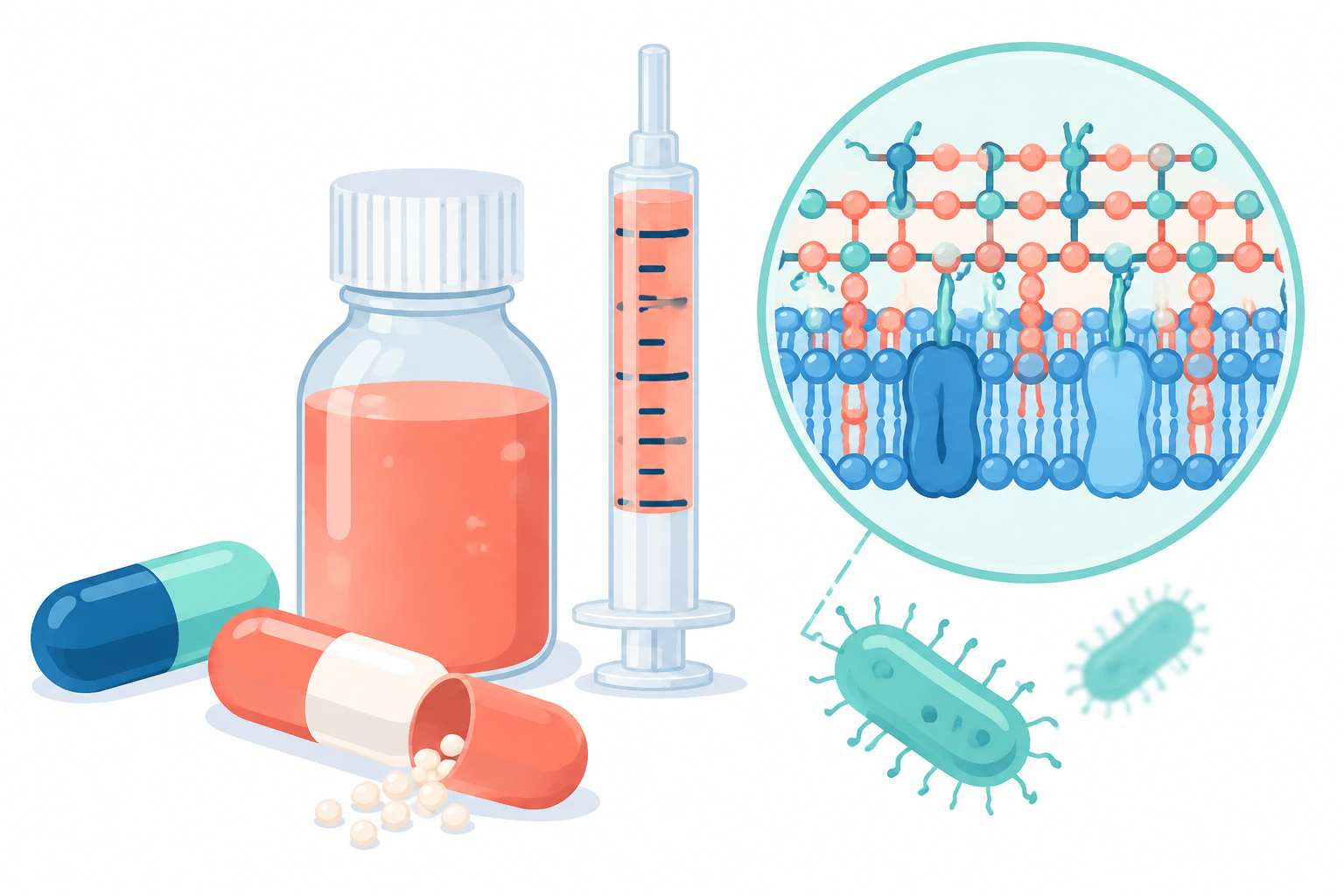
Bacteria need a strong cell wall to survive. Peptidoglycan is an important part of this wall.
Amoxicillin binds to penicillin-binding proteins, or PBPs. These proteins include enzymes that cross-link peptidoglycan strands. Blocking this step weakens the bacterial wall and can lead to bacterial death.
This makes amoxicillin bactericidal. It works best against bacteria that are actively making cell walls.
Its action is time-dependent. The important factor is how long the free drug concentration stays above the minimum inhibitory concentration, or MIC. This helps explain why regular dose intervals matter.
Some bacteria make beta-lactamase enzymes. These enzymes break the beta-lactam ring and can inactivate amoxicillin.
Clavulanic acid inhibits many beta-lactamases. Combining it with amoxicillin can restore activity against some resistant bacteria. However, it does not overcome every resistance mechanism. Amoxicillin–clavulanate is not automatically the best choice for every infection.
Side Effects
Common side effects include:
- Nausea or vomiting.
- Loose stools or diarrhoea.
- Skin rash.
- Oral or vaginal candidiasis due to changes in normal flora.
Serious reactions are less common. They include anaphylaxis, severe skin reactions and Clostridioides difficile-associated diarrhoea.
Breathing difficulty, facial swelling or collapse needs emergency care. Severe or persistent diarrhoea also needs medical assessment.
Amoxicillin often causes a rash in patients with infectious mononucleosis. It is generally avoided in this condition. Such a rash does not automatically prove a lifelong immediate penicillin allergy.
A history of a serious allergic reaction to penicillins is an important contraindication. Allergy details should be checked before dispensing.
Amoxicillin may increase methotrexate toxicity. Patients taking warfarin may need closer INR monitoring during antibiotic treatment.
3 Important Exam Points for GPAT
- Class and target: Amoxicillin is an aminopenicillin. It binds PBPs and blocks bacterial cell-wall cross-linking. Its action is bactericidal and time-dependent.
- Resistance clue: Amoxicillin is vulnerable to many beta-lactamases. Clavulanate protects it against some of these enzymes, but not all forms of resistance.
- Dose calculation trap: Read “mg/kg/day” carefully. Calculate the total daily dose first. Then divide it by the number of daily doses. Do not confuse it with “mg/kg/dose.”
3 MCQs
1. Which target is mainly responsible for amoxicillin's antibacterial action?
A. Bacterial DNA gyrase
B. Penicillin-binding proteins
C. The 30S ribosomal subunit
D. Fungal ergosterol
Answer: B
2. What is the main role of clavulanic acid in an amoxicillin combination?
A. To inhibit many beta-lactamases
B. To prevent every allergic reaction
C. To increase bacterial protein synthesis
D. To block viral replication
Answer: A
3. A 20 kg child is prescribed amoxicillin 45 mg/kg/day in two divided doses. What is each dose?
A. 225 mg
B. 900 mg
C. 450 mg
D. 1,800 mg
Answer: C
FAQs
Can amoxicillin be taken with food?
Yes. It can be taken with or without food. Taking it with food may reduce stomach discomfort.
Is amoxicillin the same as ampicillin?
No. Both are aminopenicillins, but amoxicillin is better absorbed orally. They are related drugs, not identical medicines.
Does amoxicillin treat every sore throat?
No. Many sore throats are viral. Antibiotics are used only when a bacterial cause warrants treatment.
Why should kidney function be checked?
Amoxicillin is mainly removed through the kidneys. Poor kidney function can increase drug exposure. A lower dose or longer interval may be needed.
Take Free Test on this Topic
Check what you learned with quick GPAT-style questions.
Start Free Test →Unlock all 14 Classifications and 50+ Mock Tests with our Student Pro plan.
Unlock NowFor educational use only — not medical advice. Always check doses with current prescribing information.