 DrugClass
How to Remember Diuretic Types and Side Effects for GPAT
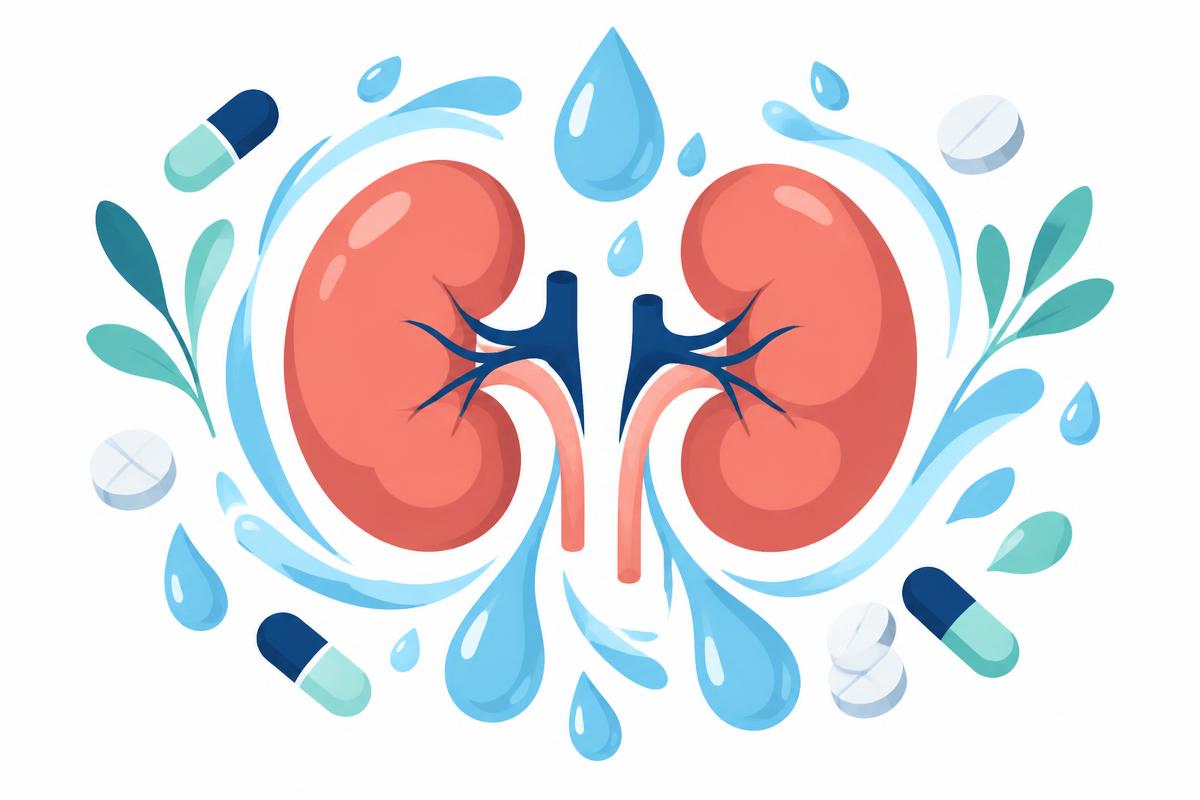
Revise diuretics by nephron site, electrolyte effects, and high-yield side effects with clear study tables.
Introduction: Why Diuretics Are Worth a Memory Map
Diuretics help the body remove water, usually by changing how the kidneys handle sodium. They appear in questions about blood pressure, heart failure, oedema, and electrolyte balance.
Their side effects make much more sense when you know the nephron site. A nephron is a tiny filtering unit in the kidney.
Study in this order: site → target → salt movement → side effect. This turns a list into a story.
Easy-Learn: Follow the Nephron
Classification by Site and Target
| Class | Examples | Main site or target |
|---|---|---|
| Carbonic anhydrase inhibitor | Acetazolamide | Mainly proximal tubule; carbonic anhydrase |
| Osmotic diuretic | Mannitol | Water-permeable nephron segments; osmotic effect |
| Loop diuretic | Furosemide, Bumetanide | Thick ascending limb; Na+/K+/2Cl− cotransporter |
| Thiazide or thiazide-like | Hydrochlorothiazide, Chlorthalidone | Distal convoluted tubule; Na+/Cl− cotransporter |
| Aldosterone antagonist | Spironolactone, Eplerenone | Late distal nephron; mineralocorticoid receptor |
| ENaC blocker | Amiloride, Triamterene | Late distal nephron; epithelial sodium channel |
The final two rows are both potassium-sparing groups. Their mechanisms are not identical.
The Electrolyte Table to Learn First
| Group | Potassium tendency | Calcium or acid–base clue |
|---|---|---|
| Loop | Can lower potassium | Increases urinary calcium loss; may cause metabolic alkalosis |
| Thiazide | Can lower potassium | Reduces urinary calcium loss; may cause metabolic alkalosis |
| Potassium-sparing | Can raise potassium | May cause metabolic acidosis |
| Acetazolamide | Can lower potassium | Bicarbonate loss can cause metabolic acidosis |
“Loops lose calcium; thiazides save calcium” is a useful exam aid. It describes kidney handling, not a guaranteed blood result in every patient.
Mechanism of Action: The Kidney Recycling Belt
Imagine the kidney as a recycling belt. Useful salt and water are picked up before the remaining fluid becomes urine.
A diuretic stops one part of that pickup system. More salt or other particles stay in the fluid. More water can remain with them and leave in urine.
Furosemide blocks a major salt pickup point in the loop. Hydrochlorothiazide blocks a later salt pickup point. That helps explain why their strength and electrolyte effects differ.
Why Potassium Can Fall or Rise
Loop and thiazide medicines send more sodium to later nephron segments. Sodium uptake there can promote potassium loss.
Amiloride blocks the late sodium channel. Spironolactone blocks aldosterone's signal. Both reduce a pathway that normally encourages potassium loss.
Do not treat “potassium-sparing” as “safe for everyone.” High potassium can be dangerous.
What can be asked in GPAT?
- Which transporter does Furosemide inhibit? Na+/K+/2Cl− cotransporter.
- Which group reduces urinary calcium loss? Thiazides.
- Which drug can cause gynecomastia? Spironolactone.
- Why can Acetazolamide cause metabolic acidosis? It increases bicarbonate loss.
- Which pairing can increase hyperkalaemia risk: an ACE inhibitor with Spironolactone? This combination can raise potassium and needs monitoring.
These are study prompts, not paper predictions.
Side Effects and Final Revision
Loop medicines can cause dehydration, low potassium, and ototoxicity in certain settings. Thiazides can cause low sodium, low potassium, and increased uric acid. They may worsen gout.
Mannitol can initially expand fluid in the circulation. It can worsen pulmonary oedema in susceptible patients. It is not a simple substitute for a loop diuretic in heart failure.
Read the loop diuretic review and the European Society of Hypertension diuretic teaching material.
For more simplified pharmacy notes and 50+ mock tests, visit our Pro Dashboard.
Take Free Test on this Topic
Check what you learned with quick GPAT-style questions.
Start Free Test →Unlock all 14 Classifications and 50+ Mock Tests with our Student Pro plan.
Unlock NowFor educational use only — not medical advice. Always check doses with current prescribing information.