 DrugClass
Explanation: Proton Pump Inhibitors Made Simple for Pharmacy Students
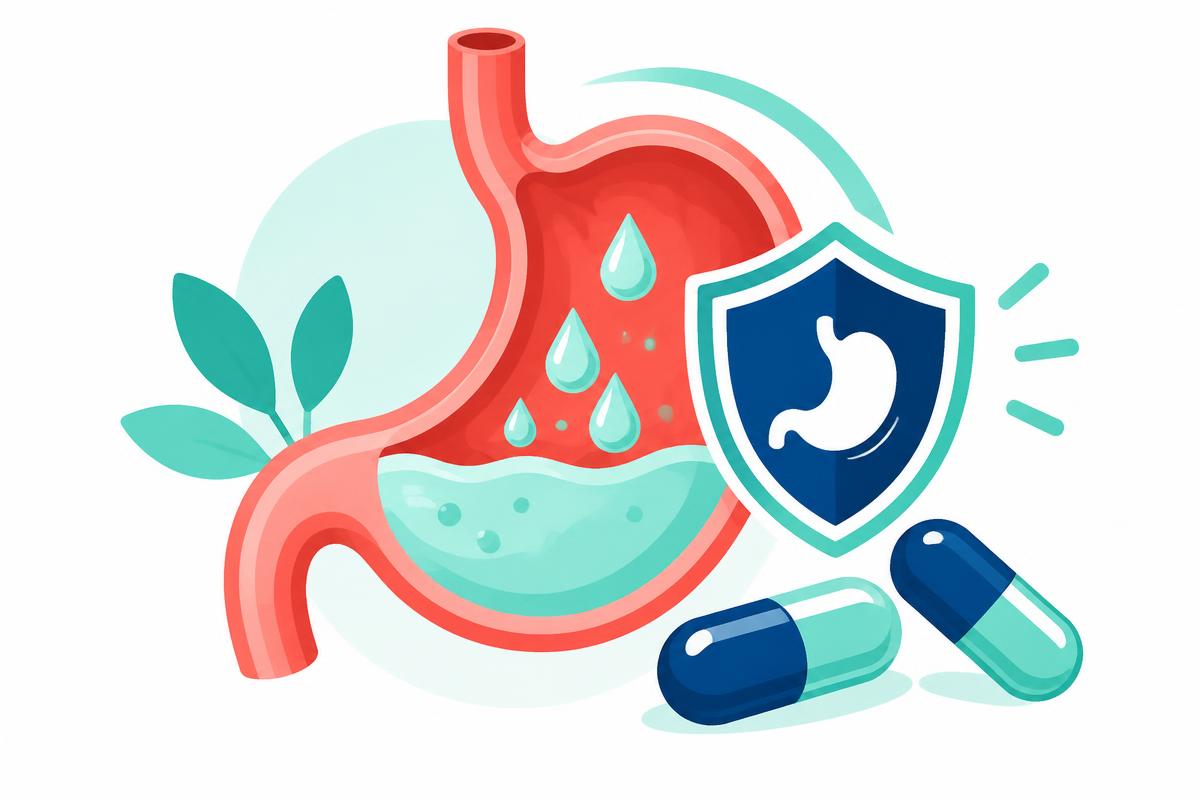
Learn how PPIs block stomach acid pumps, how they differ from other acid medicines, and what to revise for GPAT.
Introduction: Why PPIs Matter in Pharmacology
Proton pump inhibitors, or PPIs, reduce stomach acid. They are important in acid reflux, peptic ulcers, and selected ulcer-prevention plans.
Students often confuse PPIs with antacids or H2 blockers. The key difference is where they act. A PPI blocks the final acid-making pump.
For exams, connect four ideas: the drug name, pump target, activation process, and duration of action.
Easy-Learn: The Acid-Suppression Map
Recognise the Main PPI Names
- Omeprazole
- Esomeprazole
- Pantoprazole
- Lansoprazole
- Rabeprazole
- Dexlansoprazole
Most names end in “-prazole.” Use this as a first clue, not as a substitute for learning the class.
Compare Three Common Groups
| Group | Example | Main action |
|---|---|---|
| Antacid | Calcium carbonate | Neutralises acid already present |
| H2 blocker | Famotidine | Blocks a histamine signal that promotes acid release |
| PPI | Omeprazole | Inhibits the H+/K+-ATPase pump that releases acid |
Vonoprazan is a potassium-competitive acid blocker. It also suppresses acid but is not a traditional PPI. Avoid placing every acid medicine in one group.
Mechanism of Action: Close the Factory's Final Gate
Imagine a stomach parietal cell as an acid factory. Several signals tell the factory to work. The final gate sends acid into the stomach.
That gate is the H+/K+-ATPase, often called the proton pump.
A PPI reaches the acid-producing cell and becomes active in its acidic secretory space. The active form binds to pumps and inhibits them irreversibly.
Why the Effect Lasts Longer Than the Blood Level
The medicine does not need to stay in the blood all day to keep an already blocked pump inactive. Acid secretion recovers as new working pumps become available.
This is like sealing a gate. Even after the worker leaves, that gate remains closed. The factory must provide working gates again.
Most conventional oral PPIs work best when taken before a meal, because a meal activates pumps. Timing depends on the product; Dexlansoprazole has different meal-timing flexibility.
What can be asked in GPAT?
- What is the molecular target of Omeprazole? Gastric H+/K+-ATPase.
- Are PPIs reversible inhibitors of this pump? Traditional PPIs inhibit activated pumps irreversibly.
- Why can their effect outlast their plasma half-life? Pump inhibition persists until acid secretion recovers through working pumps.
- How does Famotidine differ from a PPI? It blocks H2 receptors rather than the final proton pump.
- Which PPI interaction is often discussed with Clopidogrel? Omeprazole can reduce its activation through CYP2C19 inhibition; product guidance should be checked.
These are possible revision questions, not exam predictions.
Safety, Uses, and Final Revision
PPIs may be used with antibiotics to treat Helicobacter pylori. A PPI alone does not eradicate the infection.
Common unwanted effects include headache, nausea, and diarrhoea. Long-term treatment deserves review when the original reason is no longer clear.
Low magnesium and vitamin B12 deficiency are recognised concerns in some long-term users. Studies also report associations with fractures and certain infections. An association does not prove that PPIs caused every outcome.
Do not use this list to stop prescribed treatment without advice. The useful exam lesson is to balance benefit, duration, and relevant monitoring.
Read the NCBI PPI pharmacology review for the mechanism and class details.
For more simplified pharmacy notes and 50+ mock tests, visit our Pro Dashboard.
Take Free Test on this Topic
Check what you learned with quick GPAT-style questions.
Start Free Test →Unlock all 14 Classifications and 50+ Mock Tests with our Student Pro plan.
Unlock NowFor educational use only — not medical advice. Always check doses with current prescribing information.