 DrugClass
Scabies Treatment: Drug Dose Chart and GPAT Exam Points
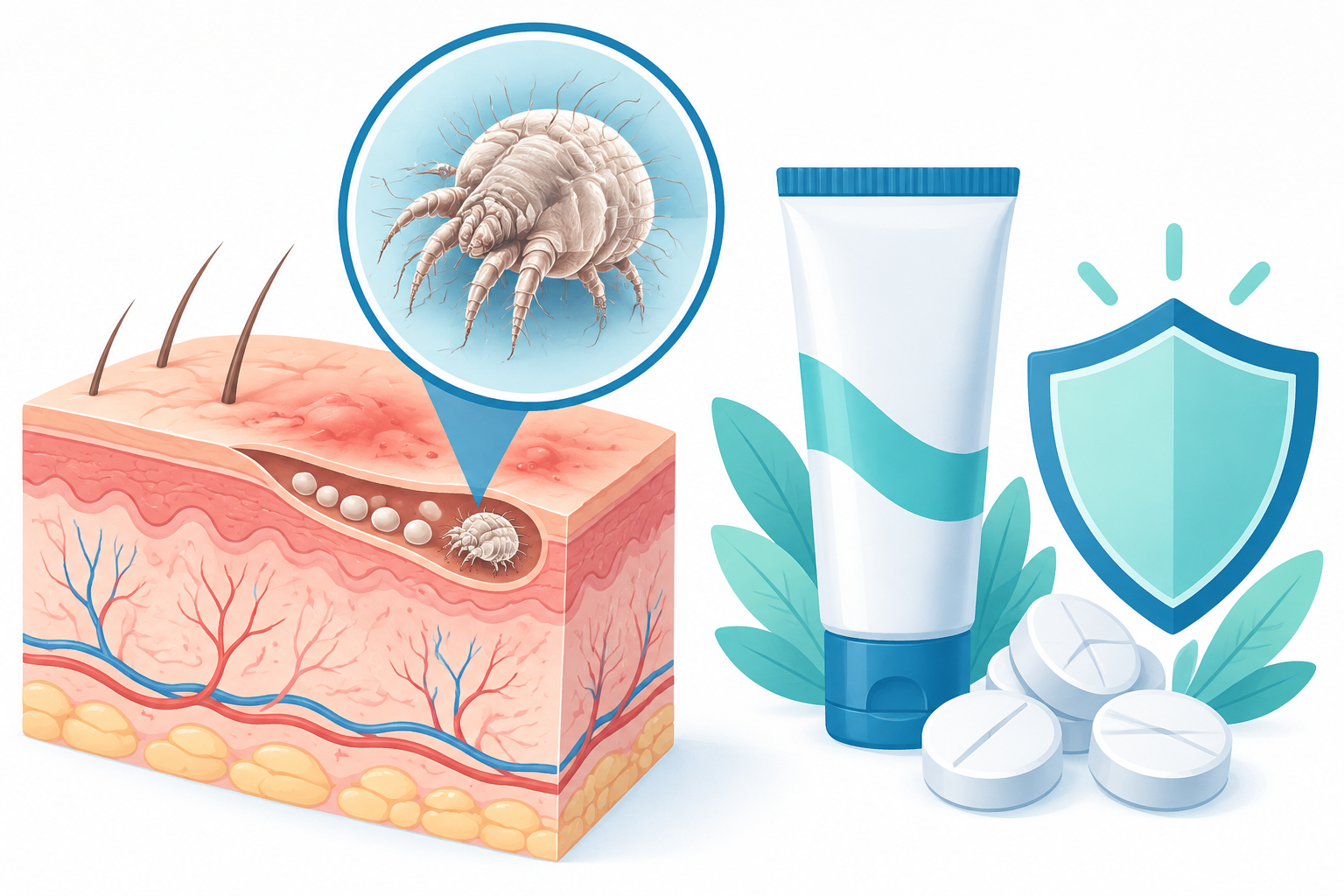
Scabies is a contagious mite infestation treated with medicines such as permethrin and ivermectin. Learn the correct doses, treat close contacts together, and remember that itching may continue after successful treatment.
What is it?
Scabies is a contagious skin disease caused by the mite Sarcoptes scabiei var. hominis. The female mite burrows into the outer skin layer. It lays eggs inside these small tunnels.
The main symptom is severe itching, often worse at night. Small bumps and thin, curved burrows may appear. Common sites include finger webs, wrists, the waist, armpits, and genital skin. In babies, the scalp, palms, and soles may also be affected.
Scabies usually spreads through prolonged skin-to-skin contact. Spread through bedding or clothing is less common in ordinary scabies. It is more important in crusted scabies. Scabies is not proof of poor hygiene.
Symptoms may take four to eight weeks to appear after a first infestation. An infected person can spread mites before itching starts. Symptoms develop faster after a repeat infestation.
Treatment must kill the mites and stop reinfestation. For GPAT, focus on permethrin, ivermectin, and treatment of close contacts.
Dose Chart
These are standard doses for uncomplicated scabies. This chart is for study, not self-prescribing. Pregnancy, young infants, and crusted scabies need clinical assessment.
| Drug / Form | Adult Dose | Child Dose |
|---|---|---|
| Permethrin 5% cream | Apply over the body from the neck down, including skin folds, finger webs, and soles. Leave for 8–14 hours, then wash off. Repeat after 7 days if needed; two applications are commonly used. | Age 2 months and above: apply over the entire body, including the head, neck, and scalp, while avoiding eyes and mouth. Leave for 8–14 hours, then wash off. Repeat after 7 days if needed. |
| Ivermectin oral tablets | 200 micrograms/kg per dose, taken with food for scabies. Give two doses, 7–14 days apart. | Children weighing at least 15 kg: 200 micrograms/kg per dose with food. Give two doses, 7–14 days apart. Safety below 15 kg is not established. |
Dose calculation: 200 micrograms/kg equals 0.2 mg/kg. A 60 kg adult needs 12 mg per dose. Tablet selection and rounding should follow the prescribed regimen.
Permethrin is generally preferred during pregnancy. Oral ivermectin is usually avoided because pregnancy safety is not established. For infants below two months, a clinician may select compounded sulfur ointment instead.
Apply permethrin carefully under the nails and between toes. Reapply it to the hands if they are washed during the treatment period. Older adults or people with scalp involvement may need head and neck treatment on medical advice.
How it Works
Permethrin is a synthetic pyrethroid. It disrupts voltage-gated sodium channel function in the mite's nerve cells. This causes prolonged nerve stimulation, paralysis, and death. It acts against mites and has activity against their eggs.
Ivermectin mainly binds to glutamate-gated chloride channels in invertebrate nerve and muscle cells. Chloride entry increases. This causes paralysis and death of the mite. It does not reliably kill eggs, so a second dose targets newly hatched mites.
Medicine alone is not enough. Follow these control steps:
- Treat household members and close contacts at the same time, even without itching.
- Wash clothes, towels, and bedding used during the previous three days in hot water. Dry with heat.
- Seal items that cannot be washed in a plastic bag for at least 72 hours, or up to one week.
- Avoid close skin contact until treatment is completed as advised.
Do not use insecticide sprays or fumigants on the body or around the home for scabies control.
Side Effects
Permethrin may cause temporary burning, stinging, redness, or increased itching. These effects are usually mild. Avoid contact with the eyes and mouth.
Ivermectin may cause nausea, diarrhoea, dizziness, headache, or rash. Patients should report severe or unusual symptoms promptly.
Itching can continue for two to four weeks after successful treatment. This happens because the immune system still reacts to mite material. It does not automatically mean treatment has failed.
A clinician may suggest an antihistamine or a mild topical corticosteroid for residual itching. These medicines relieve symptoms but do not kill mites.
New burrows, new bumps, or persistent symptoms need review. Scratching may also cause bacterial infection. Pus, increasing pain, or fever needs medical attention.
3 Important Exam Points for GPAT
- Know the correct strength: Permethrin 5% cream treats scabies. Permethrin 1% products are commonly used for head lice. Do not confuse these strengths.
- Know the repeat-dose reason: Oral ivermectin does not reliably kill mite eggs. The second dose, given 7–14 days later, helps kill newly hatched mites.
- Treat contacts together: Untreated close contacts can cause reinfestation. Crusted scabies usually needs combined oral ivermectin and topical treatment under specialist care.
3 MCQs
1. Which organism causes scabies?
A. Candida albicans
B. Sarcoptes scabiei
C. Plasmodium vivax
D. Staphylococcus aureus
Answer: B
2. What is the standard oral ivermectin dose per administration for uncomplicated scabies?
A. 20 micrograms/kg
B. 200 micrograms/kg
C. 2 mg/kg
D. 20 mg/kg
Answer: B
3. Which statement about scabies treatment is correct?
A. Only symptomatic household members need treatment.
B. Antihistamines kill scabies mites.
C. Itching always stops immediately after treatment.
D. Close contacts should be treated at the same time.
Answer: D
FAQs
Is scabies a fungal infection?
No. It is a mite infestation. Antifungal creams do not treat the cause.
Why does itching continue after treatment?
Skin inflammation can remain after the mites die. Persistent itching alone does not prove treatment failure. New burrows or worsening symptoms need review.
Can antibiotics cure scabies?
No. Antibiotics do not kill scabies mites. They may be needed if scratching leads to a secondary bacterial skin infection.
What is crusted scabies?
It is a severe form with thick crusts and very large numbers of mites. It is highly contagious. Itching may be mild or absent. Specialist treatment is essential.
Take Free Test on this Topic
Check what you learned with quick GPAT-style questions.
Start Free Test →Unlock all 14 Classifications and 50+ Mock Tests with our Student Pro plan.
Unlock NowFor educational use only — not medical advice. Always check doses with current prescribing information.