 DrugClass
Explanation: Malaria Life Cycle and Antimalarial Drugs Made Simple
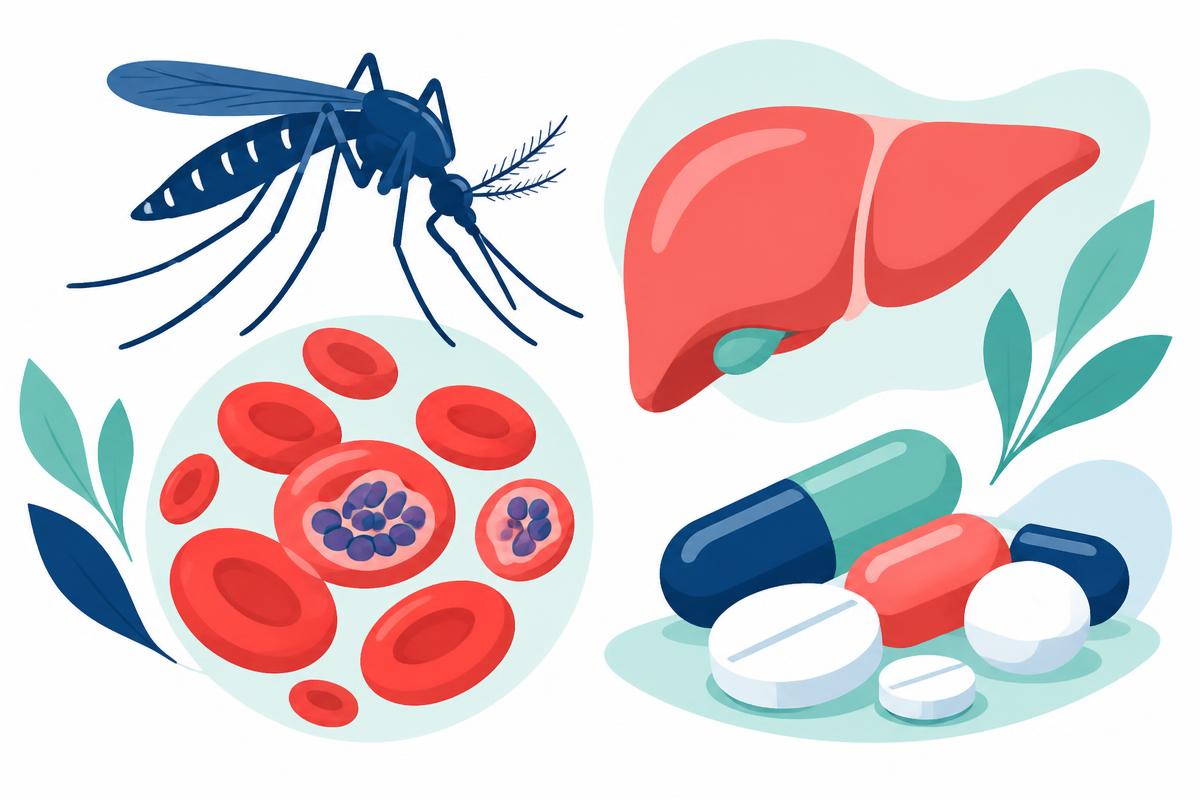
Follow malaria through liver, blood, and mosquito stages, then match antimalarial drugs and G6PD safety checks.
Introduction: Why the Malaria Life Cycle Comes First
Malaria pharmacology is easier when you know where the parasite is living. A medicine that clears blood-stage parasites may not remove dormant parasites in the liver.
That difference explains fever treatment, relapse prevention, and important safety questions. Memorising a drug list without the life cycle leaves gaps.
For exams, connect each drug group to its target stage. For treatment, species and local resistance are also essential.
Easy-Learn: Follow the Parasite's Journey
The Life Cycle in Five Steps
- An infected female Anopheles mosquito injects sporozoites during a bite.
- Sporozoites enter the liver and develop there.
- Merozoites leave the liver and enter red blood cells.
- Blood-stage multiplication and red-cell damage contribute to illness.
- Some parasites become gametocytes. Another mosquito picks them up, and sexual development continues inside the mosquito.
Plasmodium vivax and Plasmodium ovale can leave dormant liver forms called hypnozoites. These can cause relapse later. Plasmodium falciparum does not have this hypnozoite stage.
Match the Drug to the Stage
| Study group | Examples | Main teaching point |
|---|---|---|
| Blood-stage drugs | Chloroquine, Quinine, Artemether, Artesunate | Act against blood-stage infection; resistance and regimen matter |
| Dormant liver-stage drugs | Primaquine, Tafenoquine | Used for eligible patients to prevent P. vivax or P. ovale relapse |
| Transmission-stage activity | Primaquine in appropriate regimens | Can target gametocytes; use depends on guidance |
| Combination regimen example | Artemether–Lumefantrine | Artemisinin component plus a partner blood-stage drug |
Some medicines act at more than one stage. The table is a revision map, not a complete prescribing guide.
Mechanism of Action: Clear the Active Camp and the Hidden Camp
Imagine malaria parasites as two camps. The active camp is in red blood cells. A hidden camp may remain in the liver in P. vivax and P. ovale.
A blood-stage medicine clears the active camp. It may leave the hidden camp untouched. Radical cure aims to address the dormant liver reservoir as well as the blood infection.
Different Drugs Use Different Tools
Chloroquine interferes with safe handling of haem inside susceptible blood-stage parasites. Harmful haem builds up.
Artemisinin derivatives contain an endoperoxide bridge. Its activation leads to reactive products that damage parasite components.
The full mechanism of Primaquine is not reduced to one firmly established target. Its metabolites are linked to oxidative effects, and it has important liver-stage activity.
Think “different stages, different tools,” not “all antimalarials work the same way.”
What can be asked in GPAT?
- Which stage is injected by the mosquito? Sporozoites.
- Which species form hypnozoites? P. vivax and P. ovale.
- Why can blood-stage treatment alone fail to prevent relapse? Dormant liver parasites may remain.
- Which test is essential before standard radical-cure use of Primaquine or Tafenoquine? Quantitative G6PD testing.
- Why are artemisinin derivatives generally used with partner drugs? Combination regimens improve treatment reliability and help limit resistance selection.
These are practice questions, not claimed GPAT paper items.
Safety and Final Revision
Primaquine and Tafenoquine can cause haemolysis in G6PD-deficient patients. Eligibility also depends on pregnancy, age, breastfeeding circumstances, and the relevant product guidance. A class name alone is not enough to choose treatment.
Chloroquine is not a universal malaria treatment. Resistance changes which medicines can be used. Severe malaria requires urgent care; intravenous Artesunate is a key treatment in current guidance.
Read the CDC guidance on uncomplicated malaria and the NCBI antimalarial review.
For more simplified pharmacy notes and 50+ mock tests, visit our Pro Dashboard.
Take Free Test on this Topic
Check what you learned with quick GPAT-style questions.
Start Free Test →Unlock all 14 Classifications and 50+ Mock Tests with our Student Pro plan.
Unlock NowFor educational use only — not medical advice. Always check doses with current prescribing information.