DrugClass
Aminoglycoside Side Effects: Drug Dose Chart for GPAT
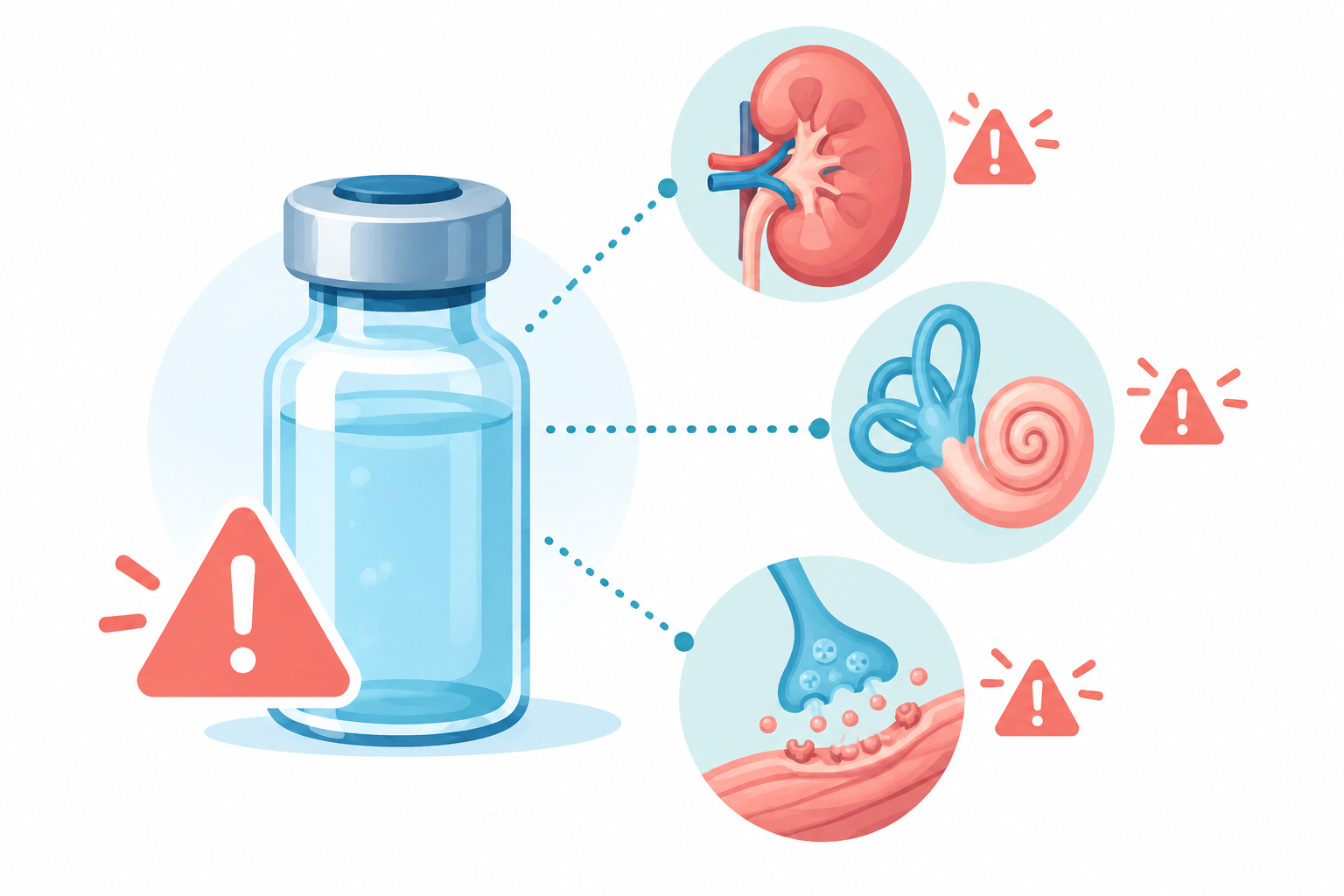
Aminoglycosides can damage the kidneys and inner ear and rarely cause neuromuscular blockade. Learn standard divided doses, monitoring needs, and high-yield GPAT facts with practice MCQs.
What is it?
Aminoglycosides are antibiotics used mainly for serious infections caused by aerobic Gram-negative bacteria. Common examples are gentamicin, amikacin, and tobramycin. They may be combined with other antibiotics for selected infections.
For B.Pharma and D.Pharma students, aminoglycoside side effects are an important pharmacology topic. The main toxic effects involve the kidneys, ears, and neuromuscular junction.
These drugs are poorly absorbed from the gut. Therefore, systemic infections usually need intravenous (IV) or intramuscular (IM) treatment. Oral neomycin acts mainly inside the bowel rather than treating infections throughout the body.
This guide is for study and revision. Injectable aminoglycosides need medical supervision, kidney assessment, and careful dose selection. They are not suitable for self-treatment.
Dose Chart
The table shows standard conventional divided-dose regimens for systemic treatment in patients with normal kidney function. Child doses below apply to infants and children beyond the neonatal period. They are not neonatal doses.
| Drug / Form | Adult Dose | Child Dose | | — | — | — | | Gentamicin, IV or IM | Common starting regimen: 1 mg/kg per dose every 8 hours | 2–2.5 mg/kg per dose every 8 hours | | Amikacin, IV or IM | 7.5 mg/kg per dose every 12 hours; usual maximum 1.5 g/day | 7.5 mg/kg per dose every 12 hours | | Tobramycin, IV or IM | Common starting regimen: 1 mg/kg per dose every 8 hours | 2–2.5 mg/kg per dose every 8 hours |
Important dose notes:
- These are examples, not universal prescriptions. The infection, severity, kidney function, and local protocol affect dosing.
- Severe infections may need higher gentamicin or tobramycin doses under specialist supervision.
- Many hospitals use extended-interval, often once-daily, regimens in suitable patients. These require a separate dosing and monitoring protocol.
- Kidney impairment requires dose reduction, a longer dosing interval, or both.
- Obesity may require an adjusted dosing weight rather than total body weight.
- Neonates need separate schedules because kidney clearance changes rapidly after birth.
Do not confuse mg/kg per dose with mg/kg per day. This distinction is a common calculation trap.
How it Works
Aminoglycosides bind to the bacterial 30S ribosomal subunit. They interfere with the start of protein synthesis and cause incorrect reading of messenger RNA. Bacteria then make abnormal proteins.
Unlike many other protein synthesis inhibitors, aminoglycosides are bactericidal. This means they kill bacteria rather than only slowing growth.
Their action is concentration-dependent. Higher peak concentrations relative to the organism's minimum inhibitory concentration generally improve bacterial killing. They also show a post-antibiotic effect. Bacterial growth stays suppressed for some time after the drug concentration falls.
Drug entry into bacteria depends on oxygen-linked transport. Therefore, aminoglycosides do not work against anaerobic bacteria.
The kidneys remove these drugs mainly by glomerular filtration. Reduced kidney function can cause drug accumulation and increase toxicity.
Side Effects
Nephrotoxicity
Aminoglycosides accumulate in proximal tubular cells and can damage them. Serum creatinine may rise. Urine output can remain normal, so normal urine volume does not rule out injury.
This kidney injury is often reversible after the drug is withdrawn, but recovery is not guaranteed.
Risk increases with:
- Pre-existing kidney disease.
- Dehydration and older age.
- Longer treatment courses.
- Excessive drug exposure or persistently high trough concentrations.
- Other kidney-toxic medicines, such as amphotericin B or vancomycin.
Ototoxicity
Damage may affect hearing, balance, or both. Unlike kidney injury, ear damage may be permanent.
- Cochlear toxicity causes tinnitus and hearing loss. High-frequency hearing may be affected first.
- Vestibular toxicity causes imbalance, dizziness, and difficulty keeping vision steady during movement.
Amikacin is classically linked more strongly with cochlear toxicity. Gentamicin and streptomycin are classically linked more strongly with vestibular toxicity. These are tendencies, not absolute rules.
Some inherited mitochondrial variants increase susceptibility to hearing loss. Furosemide and other ototoxic medicines can add to the risk, especially with kidney impairment.
Neuromuscular blockade
Rarely, aminoglycosides impair neuromuscular transmission. They reduce acetylcholine release and can also reduce postsynaptic responsiveness.
Severe weakness or respiratory paralysis may occur. Risk is higher in myasthenia gravis and with neuromuscular blocking drugs used during anaesthesia. Breathing difficulty requires emergency care.
Pregnancy and monitoring
Aminoglycosides cross the placenta. Fetal hearing damage is a concern, especially with streptomycin. Use during pregnancy needs an individual benefit–risk assessment.
Monitor kidney function before and during treatment. Drug-level monitoring depends on the regimen. Conventional dosing commonly uses peak and trough levels. Extended-interval dosing uses different sampling rules. Hearing or balance testing may be needed during prolonged treatment or in high-risk patients.
3 Important Exam Points for GPAT
- Remember “ear, kidney, muscle.” Aminoglycosides can cause ototoxicity, nephrotoxicity, and neuromuscular blockade. Ototoxicity may be irreversible; nephrotoxicity is often reversible.
- Remember “30S, killing, oxygen.” They bind to 30S ribosomes, are bactericidal, and need oxygen-linked uptake. They lack activity against anaerobes.
- Remember renal elimination. Poor kidney function increases accumulation. Dose adjustment and therapeutic drug monitoring help reduce toxicity.
3 MCQs
1. Which aminoglycoside adverse effect may be permanent?
A. Mild nausea
B. Ototoxicity
C. Injection-site discomfort
D. Temporary appetite loss
Answer: B
2. Aminoglycosides mainly bind to which bacterial structure?
A. 50S ribosomal subunit
B. DNA gyrase
C. 30S ribosomal subunit
D. Cell-wall transpeptidase
Answer: C
3. Which condition increases concern about aminoglycoside-induced neuromuscular blockade?
A. Myasthenia gravis
B. Iron deficiency anaemia
C. Hypothyroidism alone
D. Seasonal allergic rhinitis
Answer: A
FAQs
Is aminoglycoside kidney damage always permanent?
No. It is often reversible after withdrawal and appropriate care. However, severe injury can occur and needs prompt assessment.
Why are aminoglycosides ineffective against anaerobes?
Their entry into bacteria requires oxygen-linked transport. Anaerobic bacteria do not support this uptake effectively.
Can once-daily dosing prevent all toxicity?
No. Extended-interval dosing can reduce nephrotoxicity in suitable patients, but monitoring is still needed. It is not appropriate for every patient or infection.
What symptoms should patients report promptly?
New ringing in the ears, hearing changes, imbalance, reduced urine, or marked weakness need prompt medical review. Breathing difficulty is an emergency.
Take Free Test on this Topic
Check what you learned with quick GPAT-style questions.
Start Free Test →Unlock all 14 Classifications and 50+ Mock Tests with our Student Pro plan.
Unlock NowFor educational use only — not medical advice. Always check doses with current prescribing information.