 DrugClass
How to Remember 5 Important Drug–Food Interactions for GPAT
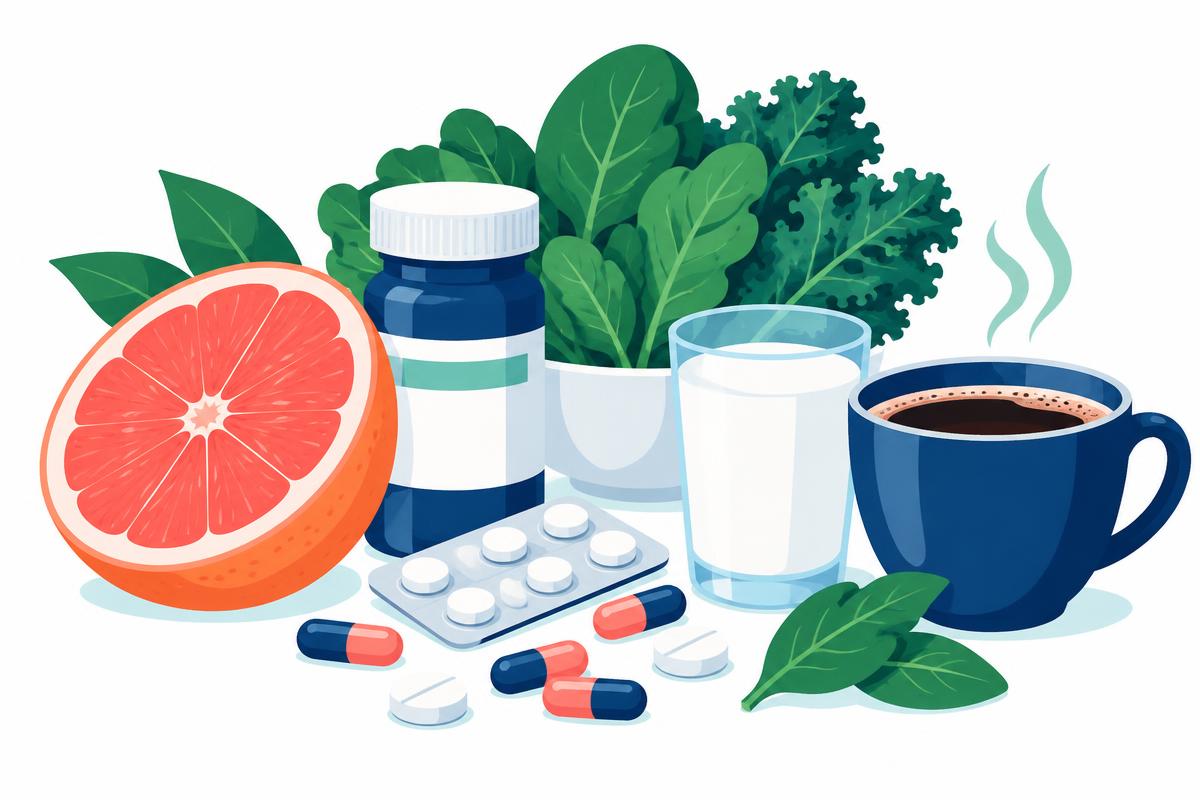
Learn five drug–food interaction patterns with practical explanations and GPAT questions.
Introduction: Why Food Interactions Matter in Exams
Food can change how much medicine enters the blood. It can also change drug breakdown or oppose a drug's effect.
These interactions are useful for GPAT and pharmacy counselling. The challenge is to explain the reason, not just repeat “avoid this food.”
Learn five patterns: opposite effect, excess messenger, blocked breakdown, binding in the gut, and reduced absorption. This is a selected high-yield list, not a measured ranking of the world's five most important interactions.
Easy-Learn: Five Interaction Patterns
The Quick Classification Table
| Medicine and food | Type of problem | Core message |
|---|---|---|
| Warfarin and major changes in vitamin K intake | Opposing pharmacological effect | Keep vitamin K intake reasonably consistent |
| Phenelzine and high-tyramine foods | Reduced tyramine breakdown | Follow the prescribed tyramine restrictions |
| Simvastatin and grapefruit | Reduced intestinal drug metabolism | Follow product-specific avoidance advice |
| Tetracycline and calcium-rich products | Binding in the gut | Check separation and formulation instructions |
| Levothyroxine and food or coffee | Reduced or inconsistent absorption | Take consistently according to product guidance |
Mechanism of Action: Five Simple Analogies
1. Warfarin and Vitamin K: Two Teams Pulling a Rope
Warfarin reduces recycling of vitamin K. This reduces production of several active clotting factors.
A major increase in vitamin K intake can reduce its anticoagulant effect. Think of vitamin K and Warfarin as teams pulling in opposite directions.
The advice is not to remove all green vegetables. Consistent intake helps clinicians interpret the INR and adjust treatment safely.
2. MAO Inhibitors and Tyramine: A Messenger Escapes the Cleaner
Monoamine oxidase normally helps break down tyramine. Older non-selective irreversible MAO inhibitors, such as Phenelzine, reduce this protective breakdown.
High-tyramine foods can then cause excessive noradrenaline release and a dangerous rise in blood pressure. Aged or fermented foods are important examples, but the exact restriction list must follow the medicine's guidance.
Not every modern medicine with MAO-related activity has identical food restrictions.
3. Grapefruit and Simvastatin: Slow Down the Breakdown Team
Grapefruit can inhibit intestinal CYP3A4. For some medicines, less drug is broken down before it reaches the blood.
With Simvastatin, this can raise exposure and increase adverse-effect risk, including muscle injury. Grapefruit does not affect every statin in the same way. Pravastatin has a different interaction profile.
Simply taking grapefruit a few hours later may not remove an interaction that lasts longer.
4. Tetracycline and Calcium: The Drug Gets Tied Up
Calcium can bind Tetracycline in the gut. This forms complexes that are poorly absorbed.
Think of the drug being tied to a weight, so less can cross into the bloodstream. Iron and magnesium can cause related interactions.
Instructions differ among tetracyclines and formulations. Do not assume milk has an identical effect on every antibiotic.
5. Levothyroxine and Breakfast: Less Gets Through the Gate
Food and coffee can reduce or change Levothyroxine absorption. Consistent administration matters because thyroid replacement depends on steady exposure.
Many tablet instructions recommend an empty stomach, 30–60 minutes before breakfast. Calcium and iron supplements generally need at least four hours of separation. Follow the specific product and prescriber's advice.
What can be asked in GPAT?
- Should patients taking Warfarin avoid all vegetables? No; consistent vitamin K intake is the central principle.
- What serious event can follow tyramine with an irreversible MAO inhibitor? A hypertensive crisis.
- Which enzyme explains many grapefruit interactions? Intestinal CYP3A4.
- Why can calcium reduce Tetracycline absorption? Chelation or complex formation.
- Why is consistent timing important for Levothyroxine? Food-related absorption changes can alter thyroid replacement.
These are original revision prompts, not exam predictions.
Quick Revision and Further Reading
Draw five arrows: oppose, accumulate, inhibit metabolism, bind, and reduce absorption. Put one interaction beneath each.
Read Medsafe's medicines and food interaction guide, the warfarin food-interaction review, and the levothyroxine absorption review.
For more simplified pharmacy notes and 50+ mock tests, visit our Pro Dashboard.
Take Free Test on this Topic
Check what you learned with quick GPAT-style questions.
Start Free Test →Unlock all 14 Classifications and 50+ Mock Tests with our Student Pro plan.
Unlock NowFor educational use only — not medical advice. Always check doses with current prescribing information.