 DrugClass
Furosemide Drug Dose: Uses, Side Effects and GPAT Notes
Furosemide is a loop diuretic used to remove excess fluid. Learn its standard starting doses, NKCC2-blocking action, major side effects, and important GPAT exam points.
What is it?
Furosemide is a loop diuretic. It helps the kidneys remove extra salt and water through urine. It is also called frusemide in some textbooks.
Doctors use it to treat oedema, which means swelling caused by excess fluid. This may occur in heart failure, kidney disease, or liver cirrhosis. Furosemide can also lower blood pressure. However, it is not usually the first choice for uncomplicated hypertension.
The drug is available as tablets, oral liquid, and injection. Oral treatment is common for ongoing fluid control. Intravenous treatment is useful when a rapid effect is needed or oral treatment is unsuitable.
For B.Pharma and D.Pharma students, this topic links renal physiology with practical prescribing. For GPAT, focus on its site of action, dose, electrolyte effects, and important interactions.
Study note: The doses below are standard starting doses for learning. Actual treatment depends on kidney function, previous diuretic use, fluid status, and response. Do not start or change treatment without a prescriber.
Dose Chart
| Drug / Form | Adult Dose | Child Dose |
|---|---|---|
| Furosemide, oral tablet or liquid, for oedema | Initial dose: 20–80 mg as a single dose. The prescriber adjusts further doses according to response. Maintenance may be once or twice daily. | Initial dose: 2 mg/kg as a single oral dose. Further dosing is adjusted by the specialist. Oral doses above 6 mg/kg per dose are not recommended. |
| Furosemide, intravenous injection, for oedema | Initial dose: 20–40 mg by slow IV injection. Further doses depend on urine output and clinical response. | Initial dose: 1 mg/kg by slow IV injection. Further dosing requires specialist assessment. |
| Furosemide, intravenous injection, for acute pulmonary oedema | A standard initial dose is 40 mg slowly IV. If the response is inadequate, 80 mg may be given after 1 hour under medical supervision. | Emergency specialist treatment. There is no single fixed dose suitable for every child. |
Important dose rules:
- These are starting doses, not universal daily targets or maximum adult doses.
- Acute pulmonary oedema is a medical emergency. Hospital protocols may use different initial doses, especially in patients already taking loop diuretics.
- Paediatric doses are based on body weight in kilograms. Neonates need separate specialist dosing guidance.
- Oral liquid strengths vary. Check the concentration before converting milligrams into millilitres.
- Oral and IV doses are not automatically interchangeable. Oral absorption is variable.
- Rapid IV administration increases the risk of hearing damage. Follow the product's administration instructions.
For routine oral use, morning dosing helps reduce night-time urination. If prescribed twice daily, the second dose is often taken early in the afternoon.
How it Works
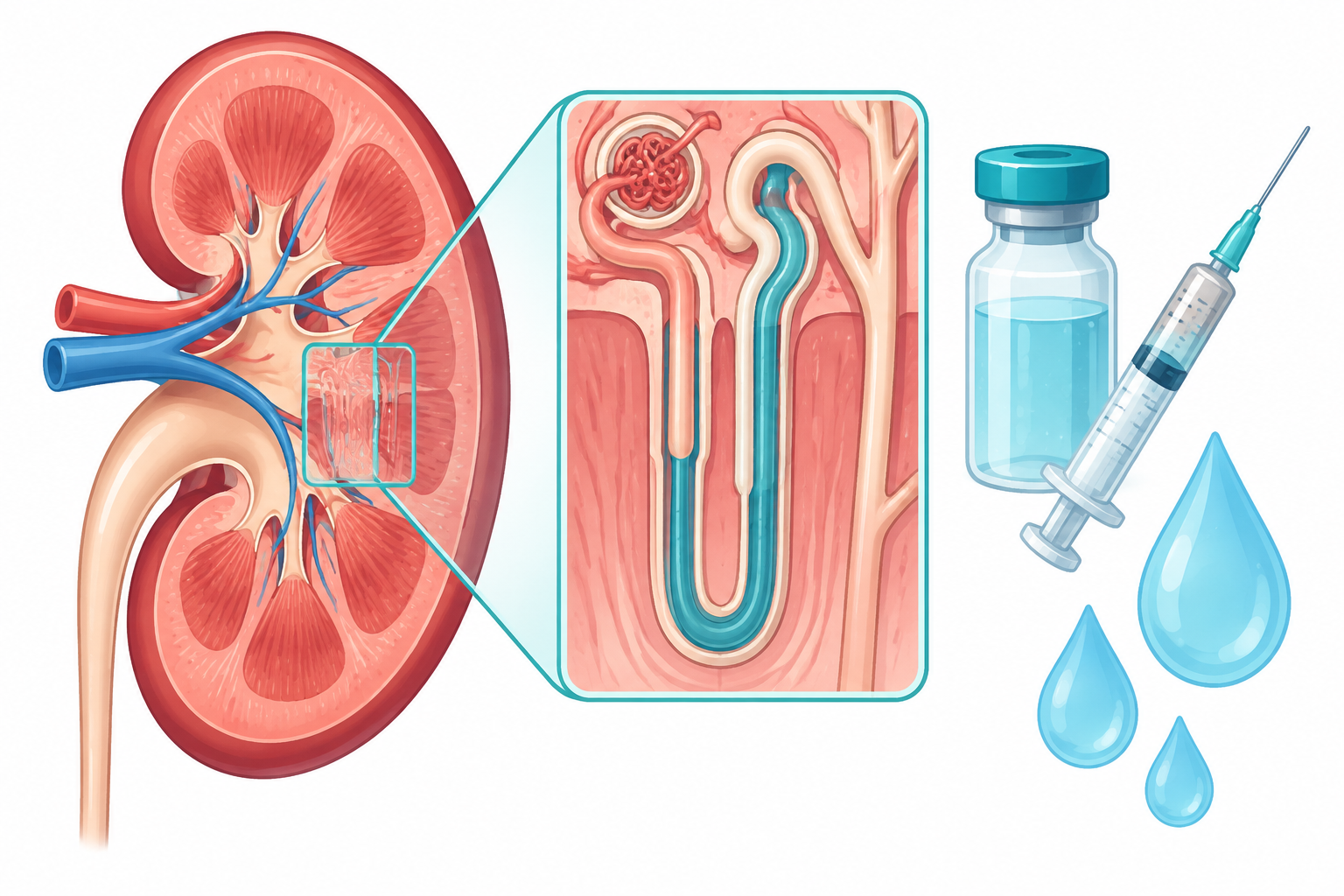
Furosemide acts mainly in the thick ascending limb of the loop of Henle.
It blocks the Na⁺–K⁺–2Cl⁻ cotransporter, also called NKCC2, on the tubular lumen side. This transporter normally helps reabsorb sodium, potassium, and chloride.
When it is blocked:
- More sodium and chloride remain in the tubule.
- Water stays with these salts and leaves in urine.
- Extra fluid in the body decreases.
- Swelling and fluid-related breathlessness may improve.
More sodium also reaches the distal nephron. This promotes potassium and hydrogen ion loss. The result can be hypokalaemia and metabolic alkalosis.
Furosemide also increases urinary calcium and magnesium loss. This is an important difference from thiazide diuretics, which reduce urinary calcium loss.
Oral action usually begins within about 1 hour. IV action begins within about 5 minutes. The oral diuretic effect commonly lasts around 6–8 hours.
Side Effects
Most adverse effects follow excess fluid or electrolyte loss.
- Dehydration: thirst, dry mouth, and reduced circulating fluid volume.
- Low blood pressure: dizziness, especially when standing.
- Hypokalaemia: muscle weakness, cramps, or abnormal heart rhythms.
- Hyponatraemia: low blood sodium.
- Hypomagnesaemia and hypocalcaemia: reduced magnesium and calcium levels.
- Metabolic alkalosis: often linked with chloride and potassium loss.
- Hyperuricaemia: may trigger gout in susceptible patients.
- Ototoxicity: tinnitus or hearing impairment, especially with rapid IV dosing, high doses, or other ototoxic drugs.
Important interactions include:
- Digoxin: low potassium increases the risk of digoxin toxicity.
- Aminoglycosides: the risk of hearing damage may increase.
- NSAIDs: these may reduce the diuretic response and worsen kidney function.
- Lithium: lithium clearance may fall, increasing toxicity risk.
Monitoring includes blood pressure, body weight, urine output, kidney function, and electrolytes. Furosemide is contraindicated in anuria. Patients should not add potassium supplements unless advised.
3 Important Exam Points for GPAT
- Site and transporter: Furosemide blocks NKCC2 in the thick ascending limb. It is a high-ceiling loop diuretic.
- Classic biochemical effect: Remember hypokalaemic metabolic alkalosis. Urinary calcium and magnesium excretion also increase.
- High-yield adverse effect: Ototoxicity is a classic association. Rapid IV administration and aminoglycoside use increase the risk.
3 MCQs
1. Which transporter is directly blocked by furosemide?
A. Sodium–glucose cotransporter 2
B. Na⁺–K⁺–2Cl⁻ cotransporter
C. Sodium–chloride cotransporter in the distal convoluted tubule
D. Epithelial sodium channel
Answer: B
2. Which acid–base disturbance is classically associated with furosemide?
A. Respiratory acidosis
B. Respiratory alkalosis
C. Metabolic alkalosis
D. Hyperchloraemic metabolic acidosis
Answer: C
3. Which drug class can increase furosemide-related ototoxicity?
A. Aminoglycosides
B. Antacids
C. H2 blockers
D. Bulk-forming laxatives
Answer: A
FAQs
Is furosemide a potassium-sparing diuretic?
No. It increases potassium loss. Spironolactone and amiloride are examples of potassium-sparing diuretics.
Why is furosemide usually taken in the morning?
It increases urination. Morning dosing helps avoid repeated trips to the toilet during the night.
Can furosemide treat every type of swelling?
No. Swelling has many causes. Furosemide mainly helps when excess body fluid is responsible. The cause needs assessment first.
What should students remember about child doses?
They are calculated in mg/kg, not as a fraction of an adult tablet. Route, age, kidney function, and clinical response also matter.
Take Free Test on this Topic
Check what you learned with quick GPAT-style questions.
Start Free Test →Unlock all 14 Classifications and 50+ Mock Tests with our Student Pro plan.
Unlock NowFor educational use only — not medical advice. Always check doses with current prescribing information.